
Technical Architecture
Cache Warming API: Freshness Before Googlebot
How a Cache Warming API refreshes prerendered snapshots so Googlebot always indexes fresh content, not stale HTML.

Article
Prerendering solves the DOM consistency and render cost problems for crawler-facing HTML. But a prerendered snapshot is only as good as its freshness. If the live page changes between snapshot generations, Googlebot indexes an outdated version of the content. The Freshness signal — Google's assessment of how recently a page's content was updated — is directly influenced by what the snapshot contains, not by the live page's modification time.
Cache warming is the infrastructure pattern that keeps prerendered snapshots current — not reactively, waiting for Googlebot to request a stale snapshot, but proactively, refreshing high-priority snapshots before Googlebot arrives.
Correction, August 2026. Earlier revisions of this article and of several pages linking to it described a "Cache Warming API" as a shipped feature of ostr.io. That was wrong, and the error propagated across this site. ostr.io documents cache purging, not warming: a full purge limited to once per two hours, and unlimited per-URL purges keyed on the
X-Prerender-Idresponse header (cache-purge docs). No prerendering vendor compared on this site publishes a warming API. Warming is therefore a pattern you assemble — invalidate, then request the URL yourself — and the rest of this article is written that way.
What Cache Warming Does
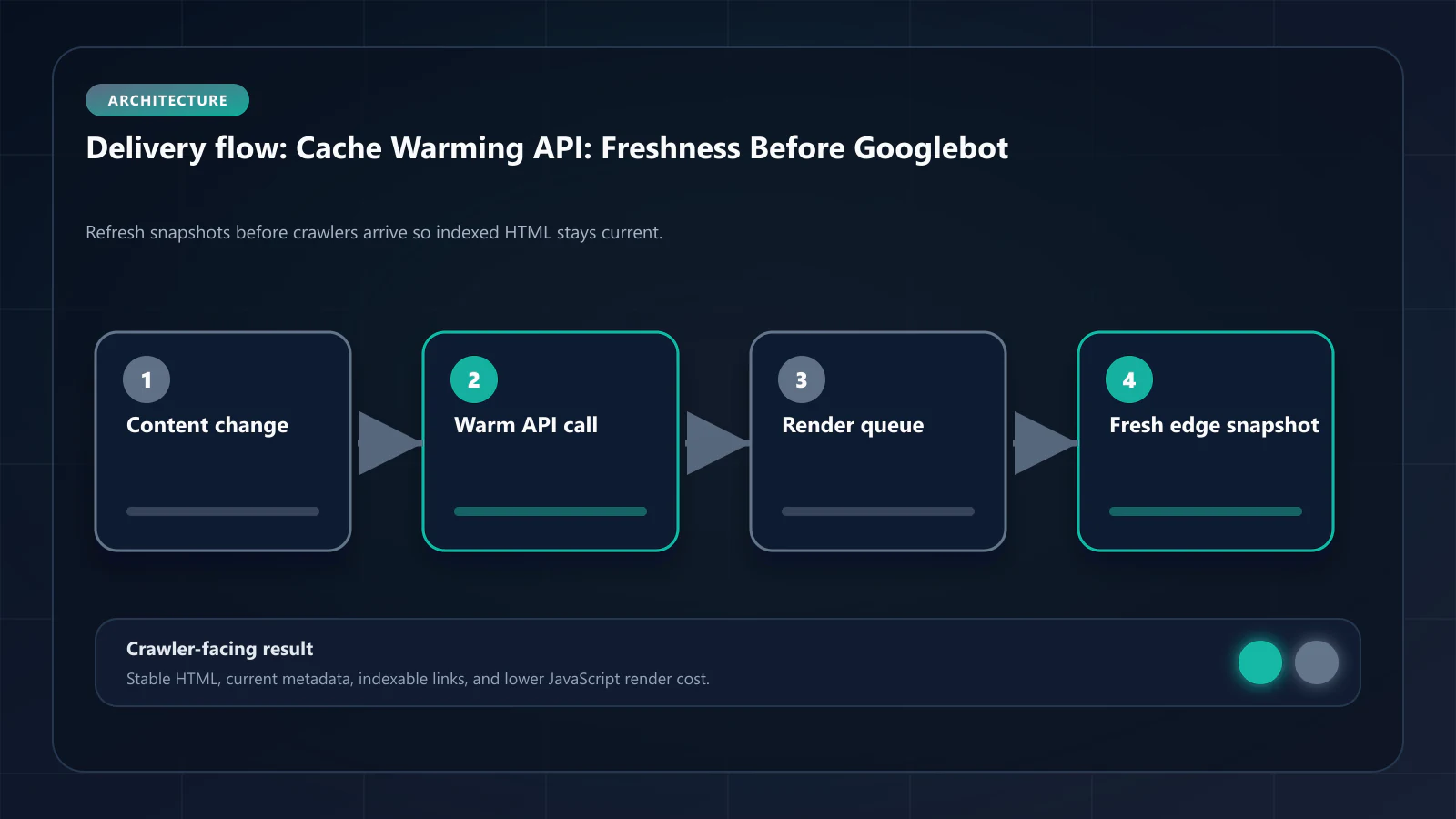
Cache warming means triggering snapshot regeneration for specific URLs or URL patterns without waiting for organic demand. Instead of relying on TTL expiration to clear stale snapshots, regeneration is triggered when content changes — or on a schedule timed to precede Googlebot's crawl window.
Mechanically it is two steps against whatever your vendor exposes: invalidate the cached entry for the URL, then fetch that URL yourself with a crawler User-Agent so the snapshot is rebuilt before a real crawler pays the render wait. Some platforms wrap both in one call; ostr.io exposes the first as a purge and leaves the second to you. Either way the important property is the same — the regeneration is driven by your publish event, not by a crawler discovering staleness.
The core operation is simple: the API receives a URL or batch of URLs, queues them for snapshot regeneration in the headless Chrome rendering pipeline, and updates the CDN cache with the new snapshots. Subsequent requests — from Googlebot, AI crawlers, or users routed to the prerender path — receive the fresh snapshot.
Why Freshness Matters for Prerendering
Google uses multiple signals to assess content freshness:
- Last-Modified HTTP header: The timestamp of the last content change on the server
- Content hash comparison: Whether the page content differs from the previously cached version
- Crawl pattern analysis: How frequently the URL changes between crawl visits
- Crawl-time content signals: The recency of dates and timestamps visible in the page content
When Googlebot visits a prerendered URL, it reads the snapshot from CDN cache. The snapshot may include dates, prices, inventory counts, or publication timestamps that reflect the state of the page at snapshot generation time — not the current state. If the snapshot is 72 hours old and the page shows "Updated: 3 days ago," Google's Freshness assessment reflects stale data.
The prerender delta — the difference between the snapshot content and the live page at crawl time — is the quantitative measure of this staleness. Cache warming targets keeping prerender delta below 5% for high-priority pages.
Implementing Cache Warming API
A basic Cache Warming API implementation connects to your prerendering pipeline and CDN:
// cache-warmer.jsconst PRERENDER_API = process.env.PRERENDER_API_URLconst CDN_PURGE_API = process.env.CDN_PURGE_URLasync function warmCache(urls) { const results = [] for (const url of urls) { try { // 1. Trigger snapshot regeneration const renderResponse = await fetch(`${PRERENDER_API}/render`, { method: 'POST', headers: { 'Content-Type': 'application/json' }, body: JSON.stringify({ url, priority: 'high' }) }) const { snapshotId } = await renderResponse.json() // 2. Wait for rendering to complete await waitForSnapshot(snapshotId) // 3. Purge CDN cache for the URL await fetch(`${CDN_PURGE_API}/purge`, { method: 'POST', body: JSON.stringify({ urls: [url] }) }) results.push({ url, status: 'warmed', timestamp: Date.now() }) } catch (error) { results.push({ url, status: 'failed', error: error.message }) } } return results}async function waitForSnapshot(snapshotId, maxWait = 30000) { const start = Date.now() while (Date.now() - start < maxWait) { const status = await fetch(`${PRERENDER_API}/status/${snapshotId}`).then(r => r.json()) if (status.complete) return status await new Promise(resolve => setTimeout(resolve, 1000)) } throw new Error(`Snapshot ${snapshotId} did not complete within ${maxWait}ms`)}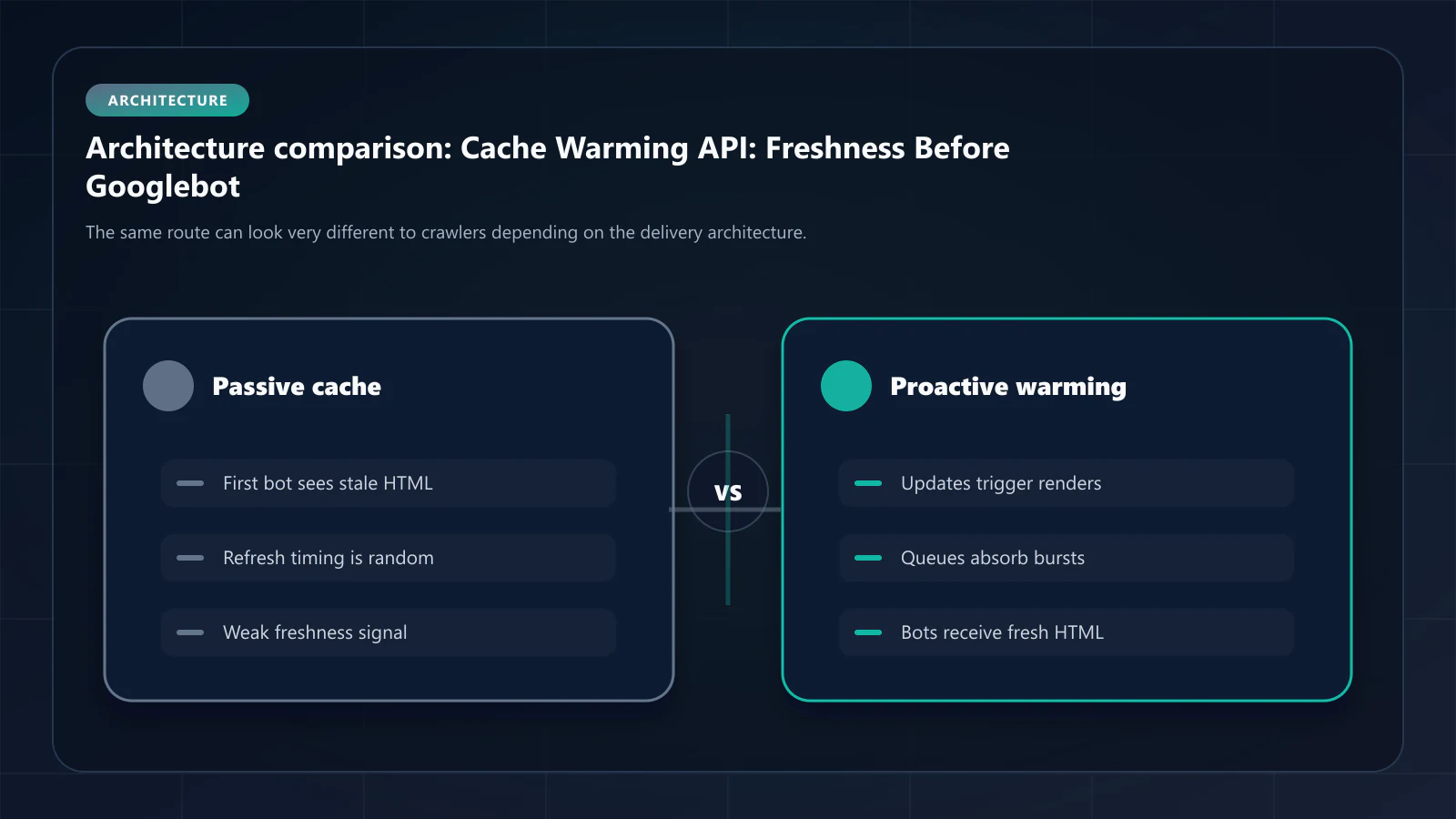
Priority-Based Warming Strategy
Warming all URLs continuously is expensive and unnecessary. Most content changes affect a small percentage of URLs at any given time. Priority-based warming directs compute resources where they matter most.
Priority 1 — Event-driven warming for changed content:
When content is published or updated, immediately trigger snapshot warming for the affected URLs. This ensures that Googlebot's next scheduled visit — which may be hours away — finds a fresh snapshot.
// Called by your CMS webhook when content changesasync function onContentUpdated(contentId, affectedUrls) { console.log(`Content ${contentId} updated. Warming ${affectedUrls.length} URLs.`) await warmCache(affectedUrls)}Priority 2 — Scheduled warming before crawl windows:
Analyze Googlebot access logs to identify when Googlebot typically crawls your domain. Schedule warming runs to precede those windows, ensuring maximum freshness when Googlebot arrives.
// Schedule warming for high-value URLs before Googlebot's typical crawl windowconst cron = require('node-cron')// Warm acquisition pages every 4 hours (Googlebot typically visits daily)cron.schedule('0 */4 * * *', async () => { const acquisitionPages = await getHighPriorityUrls() await warmCache(acquisitionPages)})// Warm all product pages once dailycron.schedule('0 2 * * *', async () => { const productPages = await getProductUrls() await warmCache(productPages)})Priority 3 — TTL-based warming on expiration:
Set cache TTL for each URL type based on content update frequency. When TTL expires, trigger a warming run rather than serving a stale snapshot.
| Template Type | Recommended TTL | Warming Strategy |
|---|---|---|
| Homepage | 1 hour | Event-driven + scheduled |
| Product pages | 4 hours | Event-driven on inventory/price change |
| Blog articles | 24 hours | Event-driven on publish/edit |
| Category pages | 6 hours | Scheduled |
| Supporting pages | 48 hours | TTL-expiration triggered |
Measuring Prerender Delta
Prerender delta measures the difference between a snapshot and the live page at a given point in time. Low delta indicates the snapshot accurately reflects current content; high delta indicates staleness.
A simple delta measurement compares key content signals:
async function measurePrerenderDelta(url) { // Fetch prerendered snapshot (as Googlebot would) const snapshot = await fetch(url, { headers: { 'User-Agent': 'Googlebot' } }).then(r => r.text()) // Fetch live page (as user would) const livePage = await fetch(url, { headers: { 'User-Agent': 'Mozilla/5.0...' } }).then(r => r.text()) // Compare key signals const metrics = { wordCountDelta: Math.abs(wordCount(snapshot) - wordCount(livePage)), priceChanged: extractPrice(snapshot) !== extractPrice(livePage), timestampDelta: extractTimestamp(snapshot) - extractTimestamp(livePage), jsonLdDelta: compareJsonLd(snapshot, livePage) } return calculateDeltaScore(metrics)}Target: prerender delta below 5% for high-priority pages, below 15% for supporting content.
Freshness Signal Impact
When Cache Warming API keeps prerender delta low, the downstream effects on Google's Freshness assessment are measurable:
- Content dates in snapshots are current: If an article was updated today, Googlebot sees "Updated: today" in the snapshot — not "Updated: last week"
- Structured data timestamps are accurate:
dateModifiedin JSON-LD reflects actual modification time, not snapshot generation time from days ago - Crawl patterns show consistent freshness: Googlebot's comparison of successive crawl snapshots shows content updating as expected, improving its assessment of the domain's freshness velocity
Teams that implement Cache Warming API alongside prerendering consistently report improved crawl frequency within 30–60 days of deployment — a direct consequence of Googlebot's freshness signals improving.
Frequently Asked Questions
Event-driven warming typically completes snapshot regeneration within 30–90 seconds of triggering. CDN cache propagation adds 5–15 seconds. The total time from content update to a fresh snapshot available to Googlebot is usually under 2 minutes.
Any CDN with a purge API supports the pattern. Cloudflare, Fastly, AWS CloudFront, and Akamai all expose programmatic purge endpoints, and the implementation adapts to each format. The friction is not the API — it is that you are purging two caches that do not know about each other. The prerendering service holds the snapshot; the CDN holds the response it served. Purge them in the wrong order and the CDN re-populates from the stale snapshot you just invalidated, which is the most common reason a "successful" warm produces no change. Write the order down: invalidate the snapshot store first, confirm regeneration, then purge the CDN. That ordering problem disappears where the CDN and the snapshot store are the same system, which is the premise behind Bridge CDN — a CDN from the same team as this site that treats crawler delivery and its cache as part of the delivery layer rather than as a service behind it. It is in development with an open waitlist and no production record, so it is not an option for the pipeline you are building this quarter; the two-cache choreography above is.
Yes. Warming all URLs continuously creates unnecessary compute load and cost. Priority-based warming — focused on high-value URLs and event-triggered refreshes — achieves the freshness benefits at a fraction of the cost of indiscriminate warming.
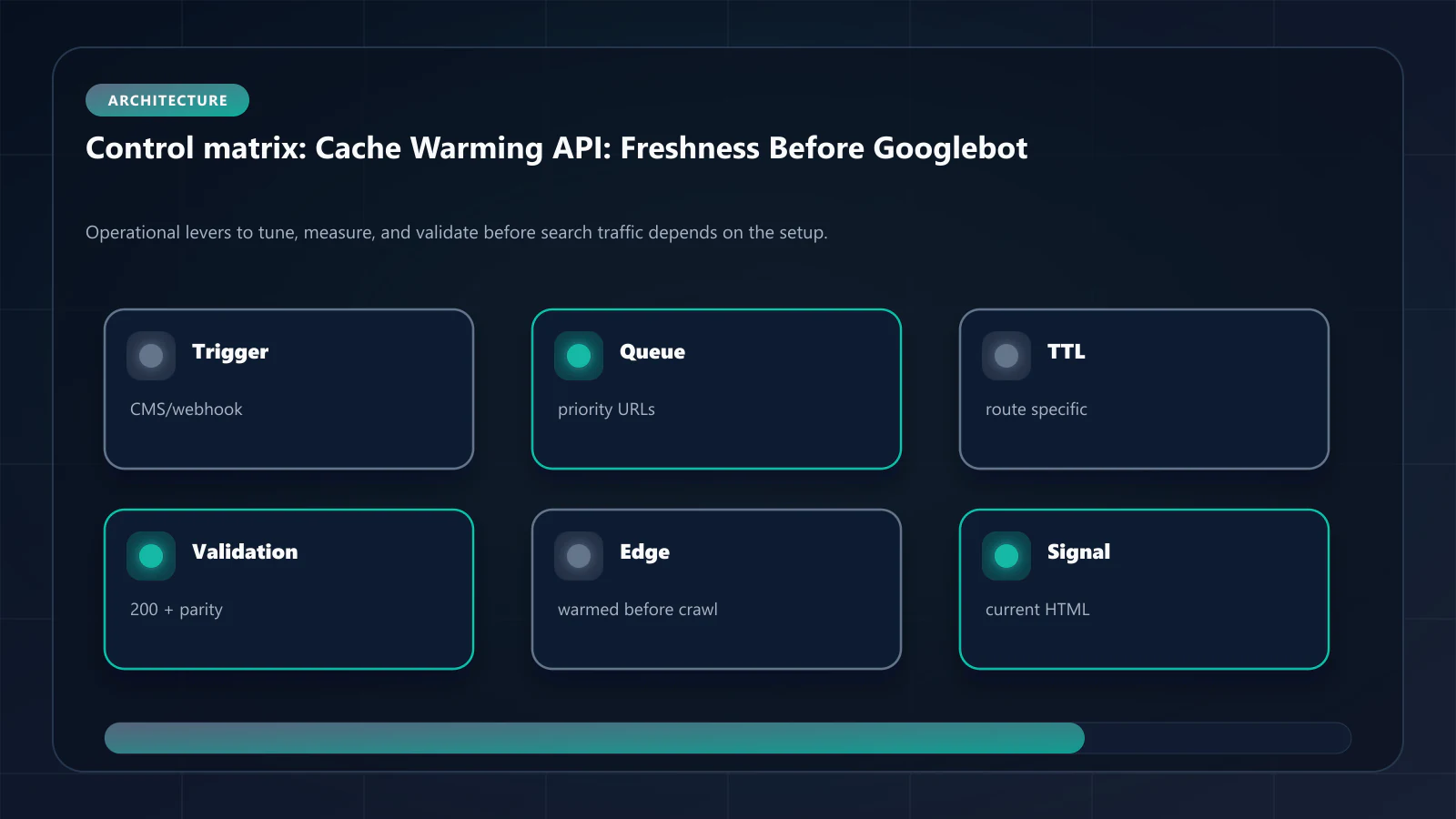
They are independent but complementary. WAF allowlisting ensures Googlebot can reach the prerendered snapshot. Cache warming ensures that snapshot is fresh when Googlebot arrives. Both must be correctly configured for optimal crawler delivery. !Raster matrix diagram of operational levers, risks, and validation checks for Cache Warming API: Ensuring Snapshot Freshness Before Googlebot Arrives.
Explore the canonical guides
Editorial trust
Written by prerender Editorial · Engineering Team. We build and run pre-rendering infrastructure for more than 200 engineering teams, which is where the numbers and code samples on this page come from.
Last updated . Editorial scope and review policy: About prerender.info.