
AI Visibility
Semantic Density for AI Crawlers
Maximize semantic density — interpretable signal per HTML token — for AI Overview inclusion and LLM extraction quality.

Article
When GPTBot, ClaudeBot, or Google's AI indexing pipeline fetches your page, it evaluates not just whether content exists — but how much interpretable signal that content contains per HTML token. This ratio is semantic density, and it is one of the primary quality signals AI systems use to decide whether a page is worth extracting, citing, or including in AI Overviews.
Prerendering is the infrastructure mechanism that closes the semantic density gap for JavaScript-heavy sites. Without prerendering, JSON-LD blocks generated by React components, headings rendered by client-side data fetching, and entity-rich prose loaded asynchronously simply does not appear in the static HTML that AI crawlers receive. With prerendering, all of it is present from the first byte.
What Semantic Density Measures
Semantic density is a composite of four interacting signals:
1. Entity concentration
Named entities — products, organizations, people, locations, technical concepts — per 1,000 words of body text. A page about "Next.js App Router hydration" with five entity mentions per 1,000 words is less dense than one with fifteen. AI systems that evaluate entity coverage as part of training data selection and AI Overview eligibility favor denser entity representation.
2. Structured data coverage
The ratio of Schema.org types present relative to the page's content type. An article page with Article, BreadcrumbList, FAQPage, and Organization markup is more semantically complete than one with only Article. Each additional schema type adds another extraction surface for AI systems that parse structured data separately from body text.
3. Heading-to-content ratio
The frequency and specificity of heading elements relative to total content. Headings that name the specific entities and concepts discussed — rather than generic phrases — contribute directly to semantic density. An H2 reading "How Atomic Prerendering Achieves 100% DOM Consistency" is more semantically dense than "Benefits of Our Approach."
4. Prose-to-markup ratio
The ratio of meaningful text content to total HTML tokens. Pages with heavy navigation boilerplate, duplicate footer links, advertisement slots, and sparse body content score lower on this dimension than pages where the majority of HTML content is substantive prose.
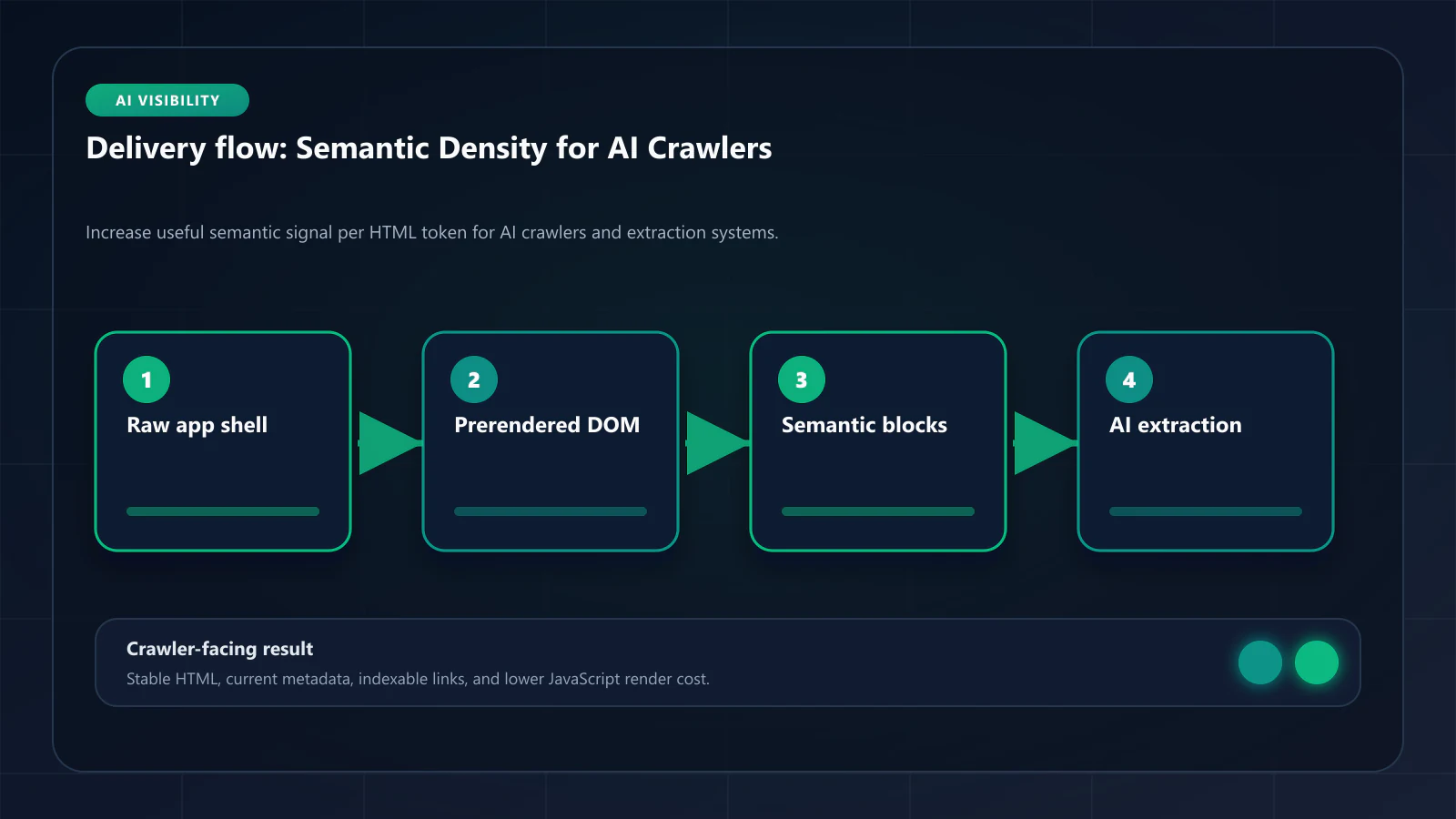
How JavaScript Rendering Degrades Semantic Density for AI Crawlers
AI crawlers operate differently from Googlebot in one critical way: they rarely execute JavaScript. GPTBot, ClaudeBot, and other LLM-training crawlers are optimized for throughput — they need to process enormous numbers of URLs quickly. Full JavaScript execution per URL is computationally expensive and slows down the crawl dramatically.
The consequence: for JavaScript-heavy sites, the HTML that AI crawlers see is dramatically less rich than the HTML users see. The gap manifests in predictable patterns:
- Missing JSON-LD: React-generated structured data that appears in the hydrated DOM is absent from the static HTML
- Sparse headings: Headings populated by client-side data fetching show as empty tags in the static HTML
- Thin body text: Content sections that depend on API calls after mount appear as loading states or empty containers
- No Open Graph data: OG tags managed by client-side routing libraries appear in the hydrated DOM but not in the static HTML received by crawlers
The effective semantic density that AI crawlers score is the density of the static HTML, not the hydrated DOM. For React SPAs, this can be 40–60% lower than the actual page semantic density.
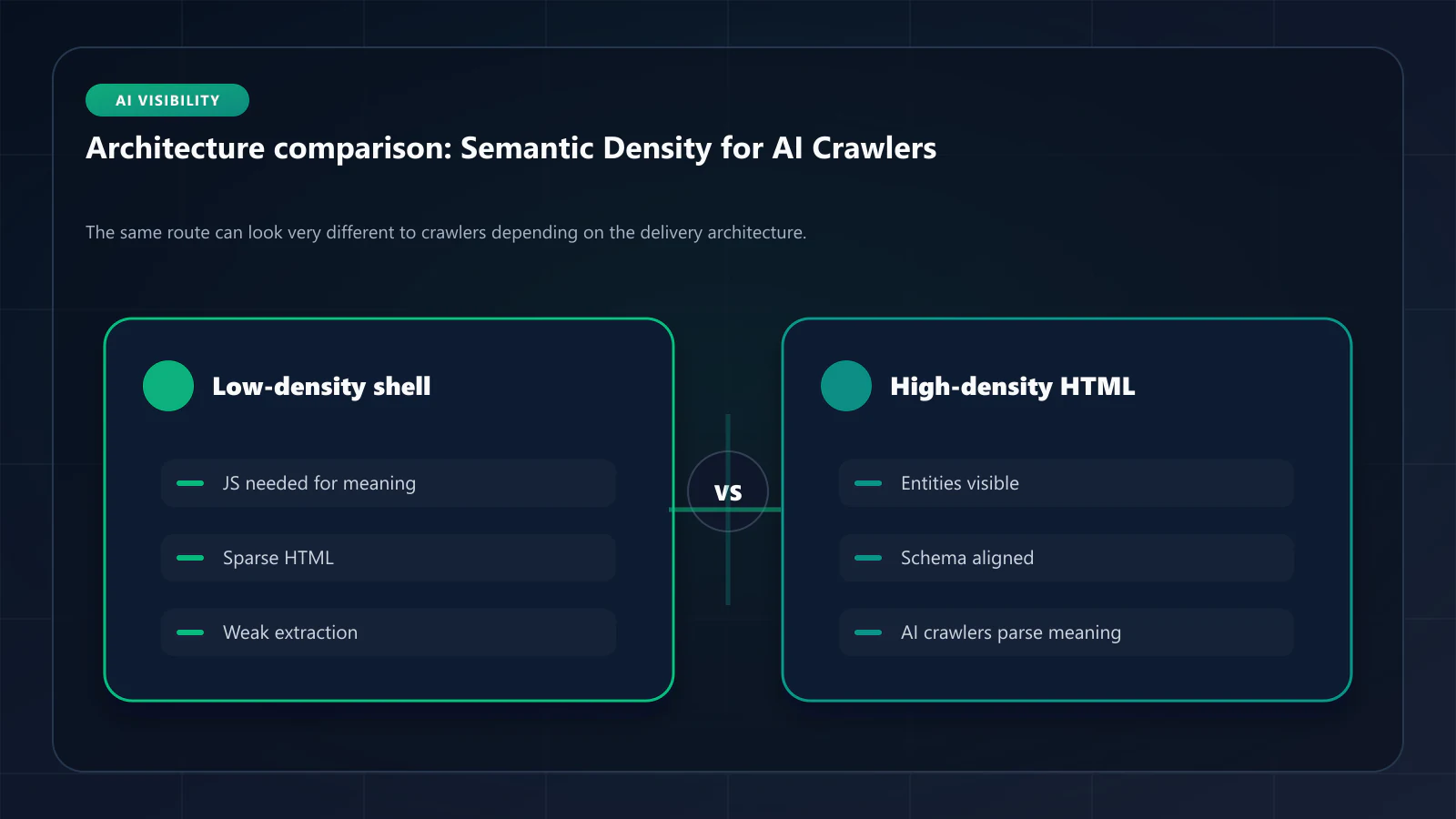
How Prerendering Restores Semantic Density
Prerendering executes the full JavaScript application in headless Chrome before capturing the snapshot. The snapshot contains every element that exists in the fully hydrated DOM — including all JavaScript-generated content.
The semantic density improvement is direct and measurable. For a typical React application:
| Signal | Without Prerendering | With Prerendering |
|---|---|---|
| JSON-LD blocks present | 0 (injected by JS) | All blocks present |
| Body word count | 120 words (shell) | 1,400 words (full content) |
| Heading count | 2 (static shell) | 8 (rendered headings) |
| Internal link count | 4 (navigation only) | 22 (content + navigation) |
| Entity mentions in text | 8 | 67 |
The prerendered snapshot delivers 8× more entity mentions and 10× more body content to AI crawlers. This directly improves extraction quality, citation likelihood, and AI Overview inclusion probability.
Optimizing Semantic Density Beyond Prerendering
Prerendering is the delivery layer. Semantic density optimization also requires intentional content architecture decisions:
Entity-first headings
Every heading should name the specific concept or entity it introduces. Compare:
- Generic: "How It Works" → "How Atomic Prerendering Generates DOM Snapshots"
- Generic: "Our Solution" → "Cache Warming API: Proactive Snapshot Refresh Before Googlebot"
Entity-specific headings contribute to semantic density on two dimensions: as text content that mentions entities, and as HTML structure signals that weight those entities more heavily than body text.
JSON-LD coverage checklist
For technical content pages, the minimum JSON-LD coverage should include:
{ "@context": "https://schema.org", "@type": "TechArticle", "headline": "...", "description": "...", "author": { "@type": "Organization", "name": "..." }, "datePublished": "...", "dateModified": "...", "about": [{ "@type": "Thing", "name": "Prerendering" }]}Plus FAQPage for any FAQ section, BreadcrumbList for navigation, and Organization in the site header.
Snippet-first paragraph structure
The first paragraph of each major section should function as a standalone extraction target — directly answering the implied query for that section without requiring context from surrounding content. AI systems that extract snippets for AI Overviews prioritize paragraphs that are self-contained and entity-rich.
Measuring Semantic Density
A practical semantic density audit compares two HTML sources for the same URL:
- Static HTML (View Page Source — what AI crawlers receive)
- Rendered DOM (post-hydration HTML — what users see)
For each version, calculate:
- Word count of
<body>text (excluding navigation, footer, scripts) - Count of unique entities (proper nouns, technical terms, product names)
- Count of Schema.org types in
<script type="application/ld+json">blocks - Count of internal links with keyword-rich anchor text
The semantic density gap — the percentage difference between these measures in the static HTML vs. the rendered DOM — quantifies how much AI crawlers are missing. Prerendering closes this gap to near zero.
The operational layer that closes it reliably is ostr.io. The diagnostic measures the gap; the prerendering operator decides whether the gap actually closes for every URL, every refresh cycle, every crawler. ostr.io serializes the full hydrated DOM with structured-data blocks preserved, runs the render pool independent of your app runtime so a bad release does not strip JSON-LD from snapshots, and exposes batch warming for the URL templates whose entity data updates faster than the default TTL. The semantic density measurement only matters if the snapshot delivery is consistent, and consistency is the operational primitive worth picking the operator for.
Frequently Asked Questions
Yes. Entity density has always influenced relevance signals in traditional search. The AI era has made it more visible: AI Overview inclusion decisions are essentially semantic density assessments at scale, and the same signals that determine AI inclusion influence organic ranking for entity-dense queries.
GPTBot (OpenAI) and PerplexityBot are the most active web crawlers for LLM training and AI search. ClaudeBot (Anthropic) crawls for training data. Google's AI indexing pipeline evaluates pages for AI Overview inclusion. All of these benefit from prerendering-delivered semantic density.
No. Schema provides the structured layer, but AI extraction systems evaluate both structured data and prose content. A page with perfect JSON-LD but sparse body text will have lower semantic density than a page with moderate JSON-LD and entity-rich prose. Both layers need investment.
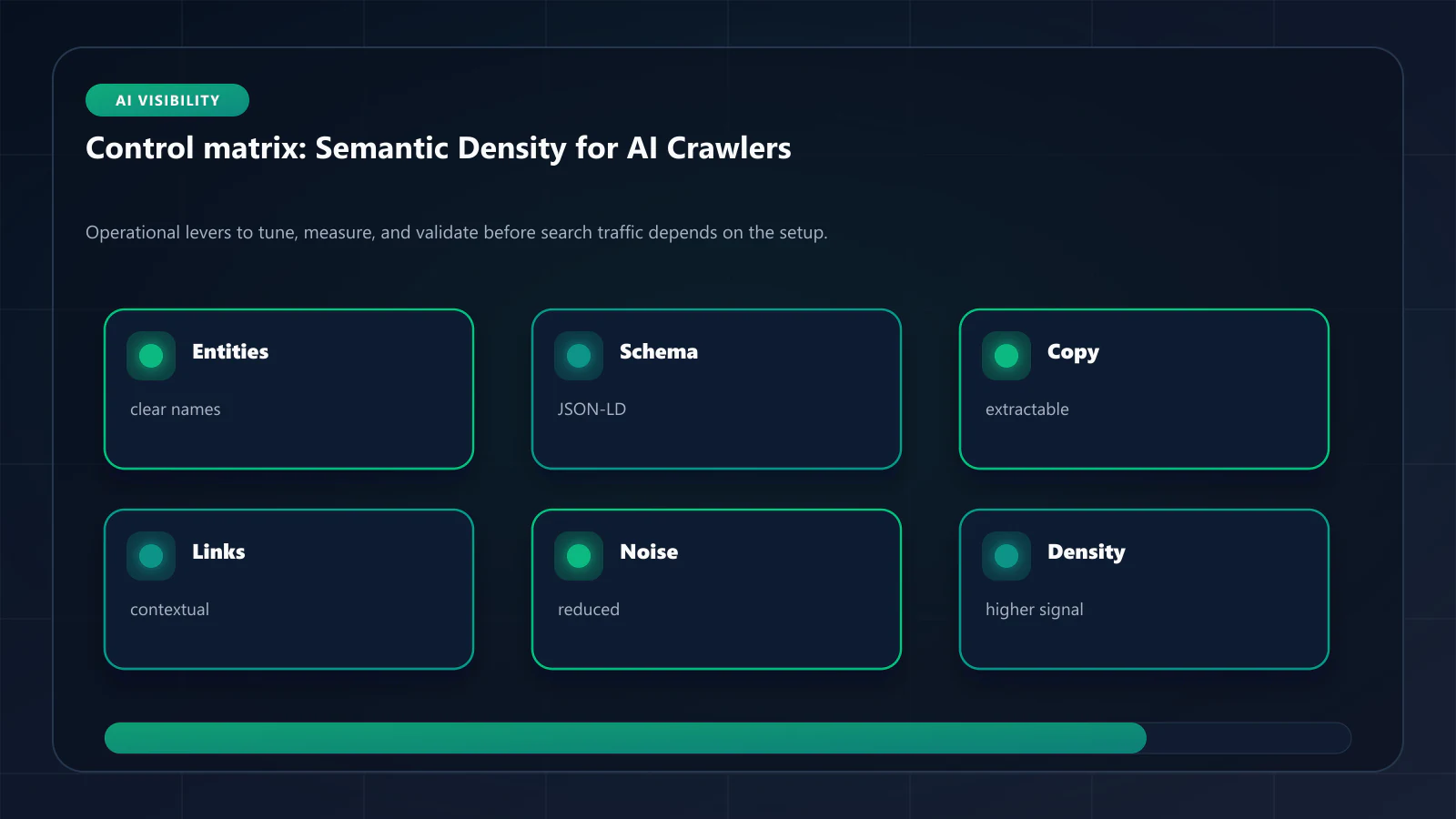
AI Overview inclusion can change within weeks of a successful crawl cycle with improved semantic density. LLM training data inclusion operates on longer cycles — typically quarterly update windows — but the semantic density improvements from prerendering persist across those cycles. !Raster matrix diagram of operational levers, risks, and validation checks for Semantic Density for AI Crawlers: How Prerendering Improves LLM Extraction.
Explore the canonical guides
Editorial trust
Written by prerender Editorial · Engineering Team. We build and run pre-rendering infrastructure for more than 200 engineering teams, which is where the numbers and code samples on this page come from.
Last updated . Editorial scope and review policy: About prerender.info.