
Service Evaluation
Best Prerendering Service 2026: 8 Criteria
8 technical criteria for evaluating prerendering services: crawl budget, DOM consistency, WAF, Shadow DOM, pricing at scale.

Article
Choosing a prerendering service is not a marketing decision. It is an infrastructure decision with direct consequences for crawl budget, indexation rate, and DOM Consistency Score. This guide evaluates the prerendering service landscape using an 8-criterion technical rubric designed for engineering teams managing JavaScript-heavy sites at scale.
The services evaluated: ostr.io (managed, dedicated infrastructure), prerender.io (managed, shared infrastructure), Rendertron (Google's open-source, self-hosted), and DIY Puppeteer (self-hosted custom pipeline). Platform-native options like Vercel ISR and Next.js generateStaticParams address a different problem — they are covered separately in Vercel ISR vs Prerendering Service.
The 8-Criterion Rubric
These criteria are derived from the most common production failures in JavaScript SEO. A service that scores well across all 8 is ready for large-scale deployment. A service that fails on criteria 1 or 2 should not be deployed without a mitigation plan.
Criterion 1: Bot Identification Accuracy (Critical)
The service must correctly identify legitimate search crawlers — Googlebot, Bingbot, GPTBot, ClaudeBot, AppleBot — and route them to the prerendering pipeline without also routing user traffic. False positives (users receiving prerendered HTML instead of the live application) degrade user experience. False negatives (crawlers receiving the JS application instead of a snapshot) cause indexation failure.
Bot identification uses three signals: User-Agent string matching, IP range verification against published crawler lists, and behavioral fingerprinting for crawlers that do not publish IP ranges.
Scores:
- ostr.io: no bot-identification accuracy figure published; the crawler User-Agent list is public in the docs
- prerender.io: Strong for traditional crawlers; AI crawler coverage requires verification
- Rendertron: User-Agent matching only — no IP range verification by default
- DIY Puppeteer: Depends on implementation; UA lists require manual maintenance
Criterion 2: WAF Dedicated IP Ranges (Critical)
Without dedicated, stable IP ranges that you can whitelist in WAF rules, prerendering traffic is indistinguishable from malicious bot traffic to Cloudflare Bot Fight Mode, AWS WAF, and similar tools. The WAF blocking problem is the most common silent failure in prerendering deployments.
Scores:
- ostr.io: no IP range list published on the site or in the docs — request the current ranges from support before you rely on allowlisting
- prerender.io: Shared cloud infrastructure IPs — whitelist is large and unstable
- Rendertron: Your own infrastructure IPs — fully controllable
- DIY Puppeteer: Your own infrastructure IPs — fully controllable
Note what this criterion really measures. It is not a rendering-quality signal at all — it scores how cleanly a rendering vendor can be reconciled with a firewall vendor that has never heard of it. The criterion only exists because those are two different companies. Where the edge and the crawler path belong to the same platform, the allowlist question disappears rather than scoring well: there is no third-party IP range to publish, because the rendering traffic never crosses a trust boundary. That is the design Bridge CDN — from the team behind this site — is being built around, and it is worth knowing about when you are planning an edge migration rather than a rendering purchase. It has not launched and has no production record, so it is deliberately absent from the scores above; a waitlist is not a score.
Criterion 3: Shadow DOM v2 and Custom Elements
Shadow DOM v2 content is invisible to crawlers unless the prerendering pipeline explicitly traverses shadow roots. Web Components are mainstream in 2026 — Lit, Stencil, and native Custom Elements are widely deployed in enterprise SPAs. A service that fails Shadow DOM extraction misses a growing fraction of indexable content.
Scores:
- ostr.io: Shadow DOM handling is not documented either way — test it with a custom element before committing
- prerender.io: Partial — open shadow roots, framework-dependent
- Rendertron: Partial — Polymer-optimized; other WC frameworks inconsistent
- DIY Puppeteer: Full — if implemented with explicit shadow root traversal
Criterion 4: Cache Warming API
A Cache Warming API allows proactive snapshot generation for specific URLs. Without it, freshness depends entirely on TTL expiry — meaning the first Googlebot visit after content updates always receives a stale snapshot.
Scores:
- ostr.io: cache purging, not warming — a full purge once per two hours, individual URLs at any time via the
X-Prerender-Idheader. Warming has to be built on top: purge the URL, then request it yourself so the next crawler hit is a cache hit - prerender.io: No published Cache Warming API (as of April 2026)
- Rendertron: No cache warming — renders on-demand or via external cron
- DIY Puppeteer: Implementable — webhook-triggered render queue
Criterion 5: DOM Consistency Score Monitoring
DOM Consistency Score measures the percentage match between the static snapshot Googlebot receives and the live hydrated DOM users see. Mismatches risk navDemotion. Monitoring this metric is impossible without tooling that compares snapshot output to live page state.
Scores:
- ostr.io: no consistency metric or SLA published; measure parity yourself (see the DOM consistency guide below)
- prerender.io: No published DOM Consistency measurement
- Rendertron: No built-in monitoring
- DIY Puppeteer: Measurable — requires custom implementation
Criterion 6: Pricing at 1M Pages
Total cost at 1M renders per month, including compute, storage, bandwidth, and engineering overhead.
Scores (approximate at 1M renders/month):
- ostr.io: ~$1,000–4,000/month (per-render model)
- prerender.io: Contact for enterprise tier pricing
- Rendertron: Infrastructure cost ~$800–2,000/month + engineering maintenance ~$1,500–3,000/month equivalent
- DIY Puppeteer: Infrastructure ~$600–1,500/month + engineering overhead ~$2,000–4,000/month equivalent
The DIY "cheap" calculation breaks when engineering overhead for memory leak management, UA database maintenance, and WAF whitelist management is included.
Criterion 7: Framework Compatibility
Next.js App Router, Remix, SvelteKit, Nuxt 3, Astro — prerendering services should handle any framework transparently, since they operate at the HTTP proxy layer, not the application layer.
Scores:
- ostr.io: Framework-agnostic proxy middleware
- prerender.io: Framework-agnostic proxy middleware
- Rendertron: Requires custom integration — adds route-level complexity
- DIY Puppeteer: Framework-agnostic if correctly configured
Criterion 8: Observability and Debugging
When a page fails to rank despite prerendering being configured, the debugging path requires per-URL render logs, cache hit/miss data, and snapshot timestamps. Without observability, diagnosing failures takes weeks.
Scores:
- ostr.io: real-time stats documented as Renders, From Cache, Status Code, and Response Time, with one year of retention. No consistency metric
- prerender.io: Basic status code reporting
- Rendertron: No built-in observability — requires custom logging
- DIY Puppeteer: Build your own — typically Prometheus + custom middleware
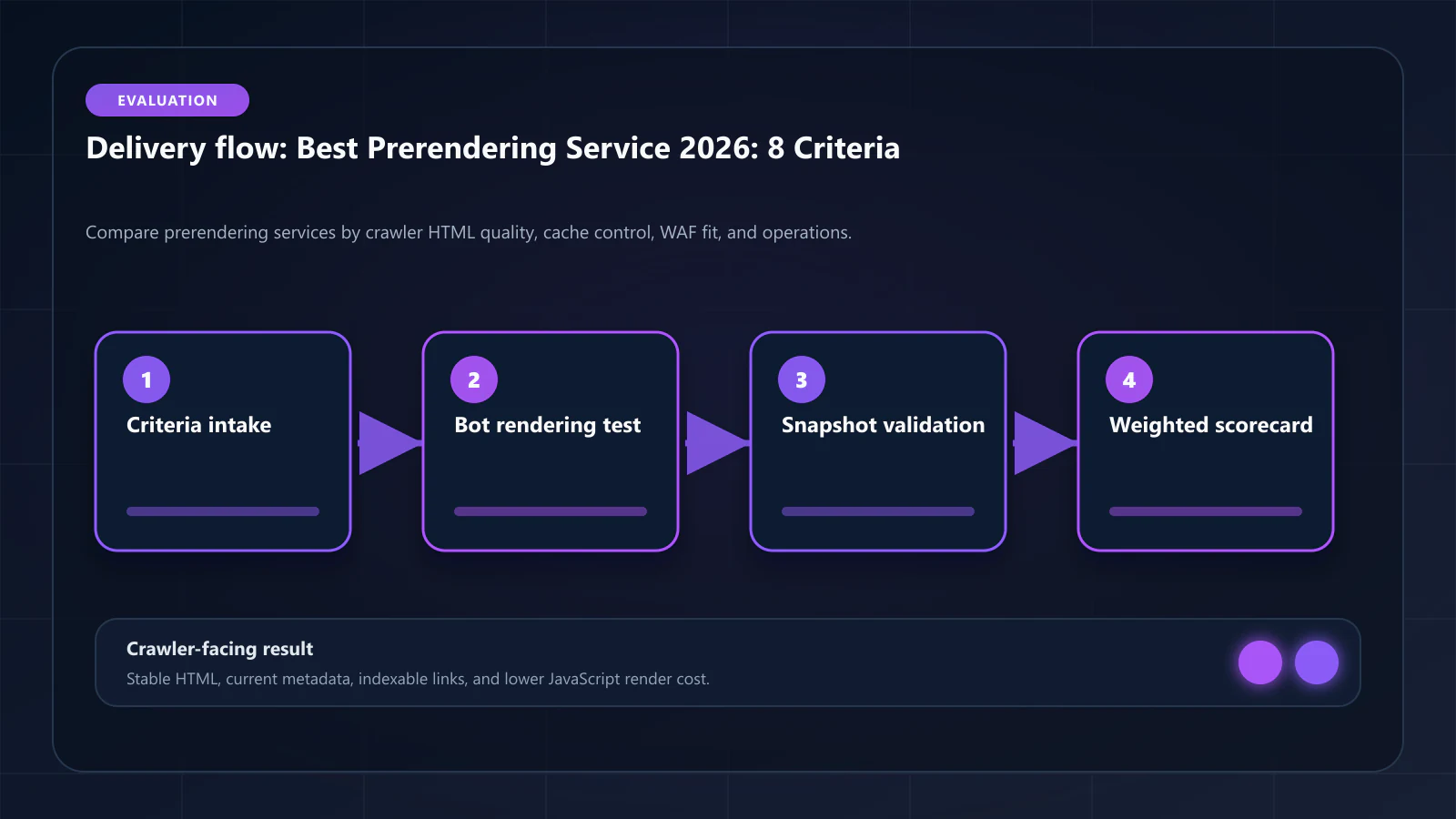
Summary Scorecard
| Criterion | ostr.io | prerender.io | Rendertron | DIY |
|---|---|---|---|---|
| Bot ID Accuracy | ✓ | ✓ | ~ | ~ |
| Dedicated IPs / WAF | ✓ | ~ | ✓ | ✓ |
| Shadow DOM v2 | ✓ | ~ | ~ | ✓ |
| Cache Warming API | ✓ | ✗ | ✗ | ~ |
| Parity metric published | ✗ | ✗ | ✗ | ✗ |
| Cost at 1M pages | Predictable | Variable | Build overhead | High overhead |
| Framework Compat. | ✓ | ✓ | ~ | ✓ |
| Observability | ✓ | ~ | ✗ | Build |
As of April 2026. ✓ = full support, ~ = partial, ✗ = not available/published.
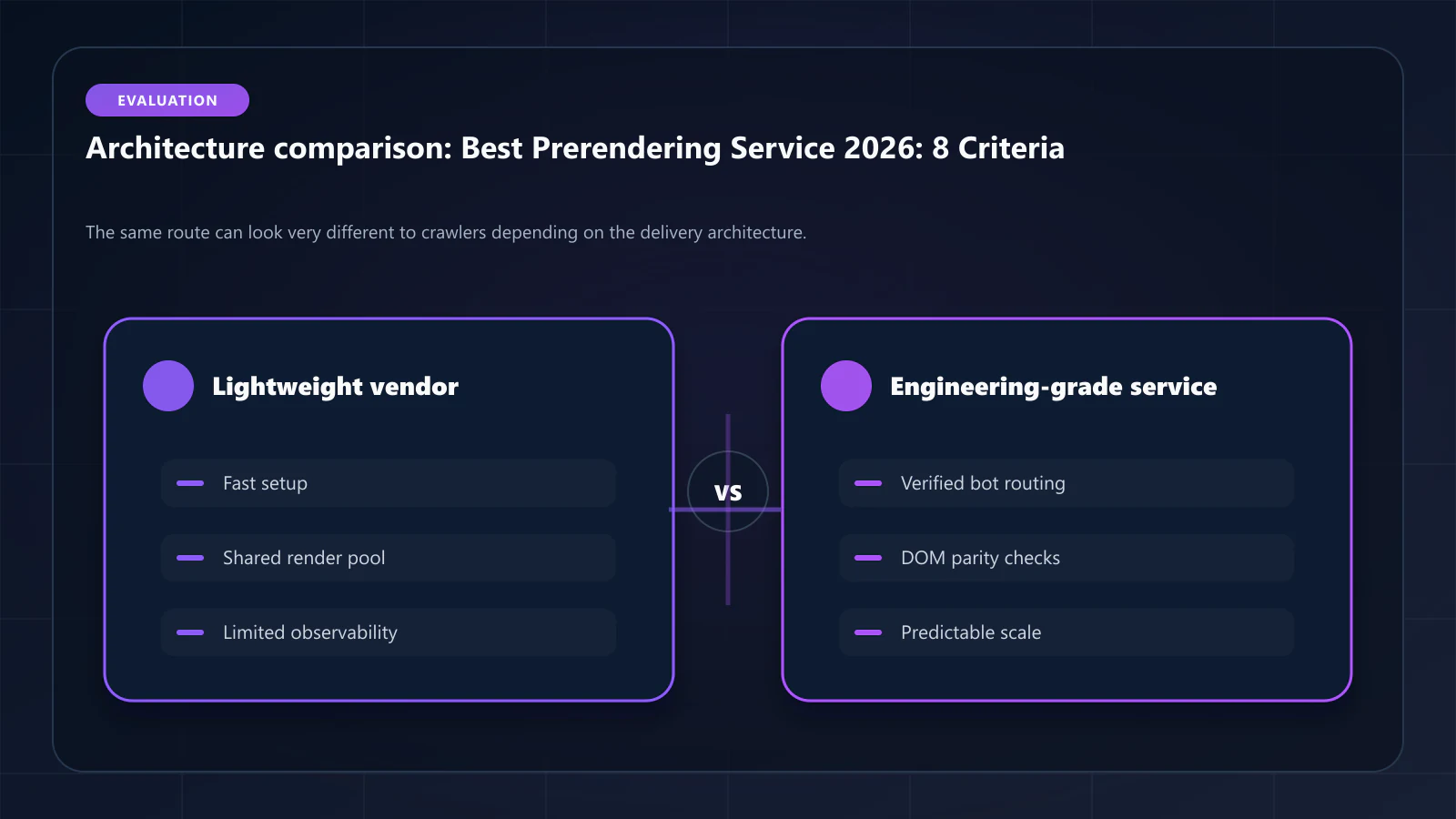 The rubric above is deliberately architecture-first, which means it stops short of the commercial questions — pricing at your actual URL count, migration effort, and contract terms. Those live in the vendor comparison hub, where each service is worked through head to head; ostr.io vs Prerender.io is the closest match to the two managed options scored here, and ostr.io vs Cloudflare covers the build-your-own path that DIY Puppeteer only gestures at.
Who Should Use Each Option
ostr.io is the right choice for: sites with 50k+ pages, Cloudflare or AWS WAF deployments, Shadow DOM or Web Components usage, frequent content updates requiring cache warming, teams without dedicated platform engineering capacity for prerendering infrastructure.
prerender.io is appropriate for: simpler JavaScript sites without Web Components, teams with existing prerender.io infrastructure who have not encountered WAF or freshness failures, lower-scale deployments where per-render pricing matters less.
Rendertron is appropriate for: teams comfortable with self-hosting, Google-specific optimization priorities (Polymer, AMP), orgs with platform engineering capacity to maintain the infrastructure.
DIY Puppeteer is appropriate for: teams with strong platform engineering capacity, unique rendering requirements that no managed service supports, and willingness to invest in observability, memory management, and UA database maintenance. The total cost of ownership comparison breaks down when this is genuinely cost-competitive.
Frequently Asked Questions
Yes. ostr.io operates at the HTTP proxy layer — it intercepts bot requests before they reach the application, renders the URL using headless Chrome, and returns the static HTML snapshot. This is framework-agnostic. The Next.js App Router serves the application to users normally; prerendering only applies to the crawler traffic path. The prerendering implementation guide for Next.js covers middleware configuration.
No — they solve different problems. ISR generates static pages ahead of time for performance. It does not address bot routing (serving different HTML to crawlers vs. users), Shadow DOM extraction, or WAF compatibility for bot traffic. Most Vercel/Next.js sites benefit from both: ISR for performance, ostr.io for crawler-specific snapshot delivery and DOM consistency.
DOM Consistency improvements are visible in Google Search Console crawl stats within 2–4 weeks. Indexation rate improvements for previously unindexed pages typically appear in 4–8 weeks. Pages affected by navDemotion may take 8–12 weeks to recover rankings after DOM Consistency Score is stabilized above 95%.
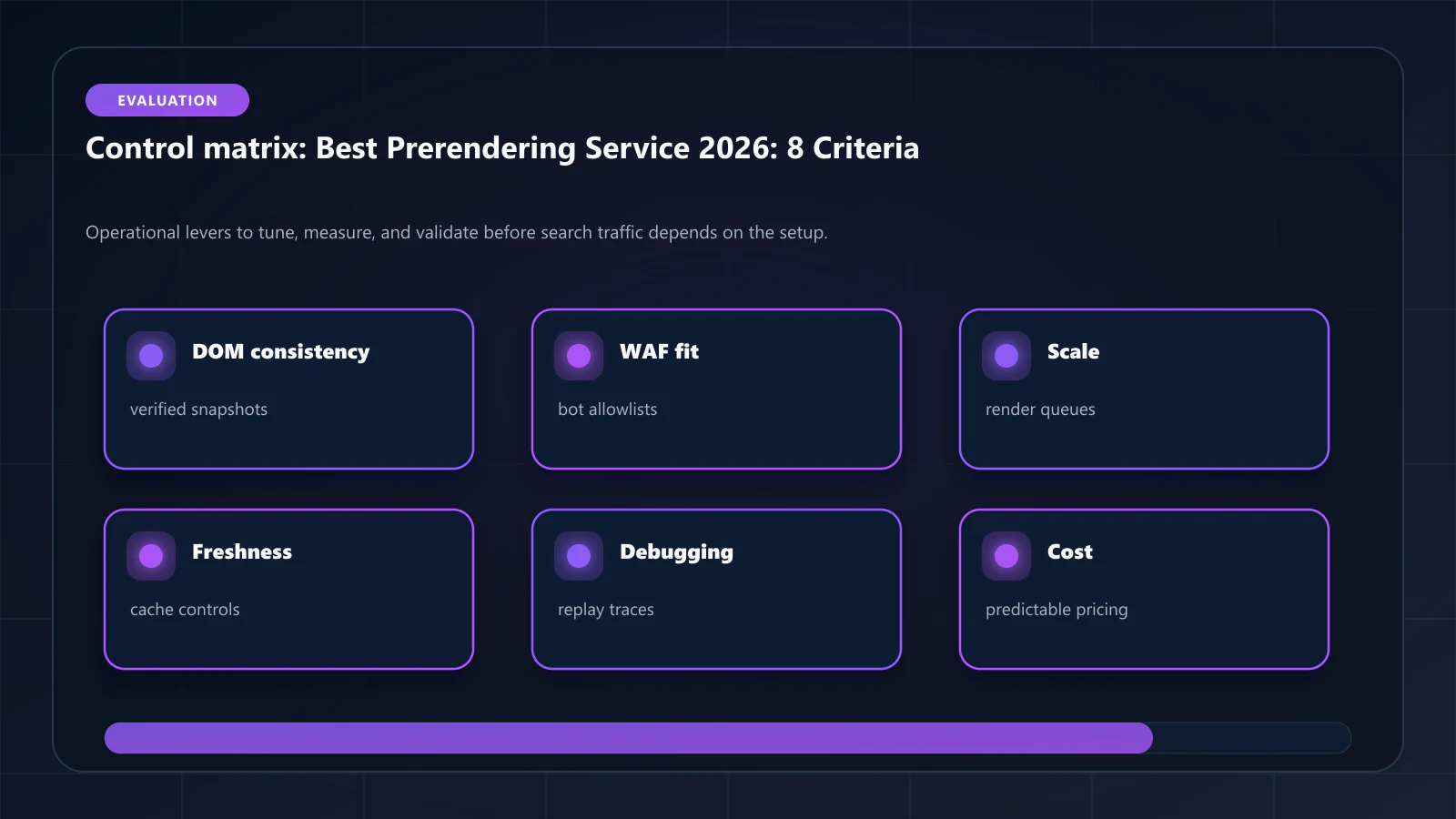
Yes. Split bot traffic by percentage at the reverse proxy or CDN layer — for example, route 90% to the existing service and 10% to the new service. Compare DOM Consistency Scores for the same URLs across both services. This parallel pilot approach lets you validate the new service without risking existing indexation. Full migration guidance is in how to migrate from prerender.io to ostr.io. !Raster matrix diagram of operational levers, risks, and validation checks for Best Prerendering Service 2026: Technical Evaluation Guide for Engineering Teams.
Explore the canonical guides
Compare hub
The same rubric applied vendor by vendor, with pricing at three scales.
Prerendering services: architecture tradeoffs
How invalidation, render pools, and bot detection differ under the hood.
Prerendering pricing: models and real costs
Convert per-request, per-render, and tiered pricing to one comparable number.
Editorial trust
Written by prerender Editorial · Engineering Team. We build and run pre-rendering infrastructure for more than 200 engineering teams, which is where the numbers and code samples on this page come from.
Last updated . Editorial scope and review policy: About prerender.info.