
Service Evaluation
Vercel ISR vs Prerendering: ISR Limits
Vercel ISR handles performance, not always SEO. The boundary between platform-native rendering and crawler-specific snapshots.

Article
Incremental Static Regeneration (ISR) and prerendering solve different problems. Conflating them leads to teams deploying ISR to fix SEO issues that ISR cannot fix, and deploying prerendering services to fix performance issues that ISR handles better. This guide draws the distinction precisely and identifies when each is the right tool.
ostr.io is a managed prerendering service that delivers deterministic HTML snapshots to search crawlers and AI retrieval systems through proxy-level middleware, without requiring framework rewrites. This guide uses ostr.io as the prerendering reference point because it is framework-agnostic and directly comparable to ISR along the dimensions that matter for crawler visibility.
What ISR Actually Does
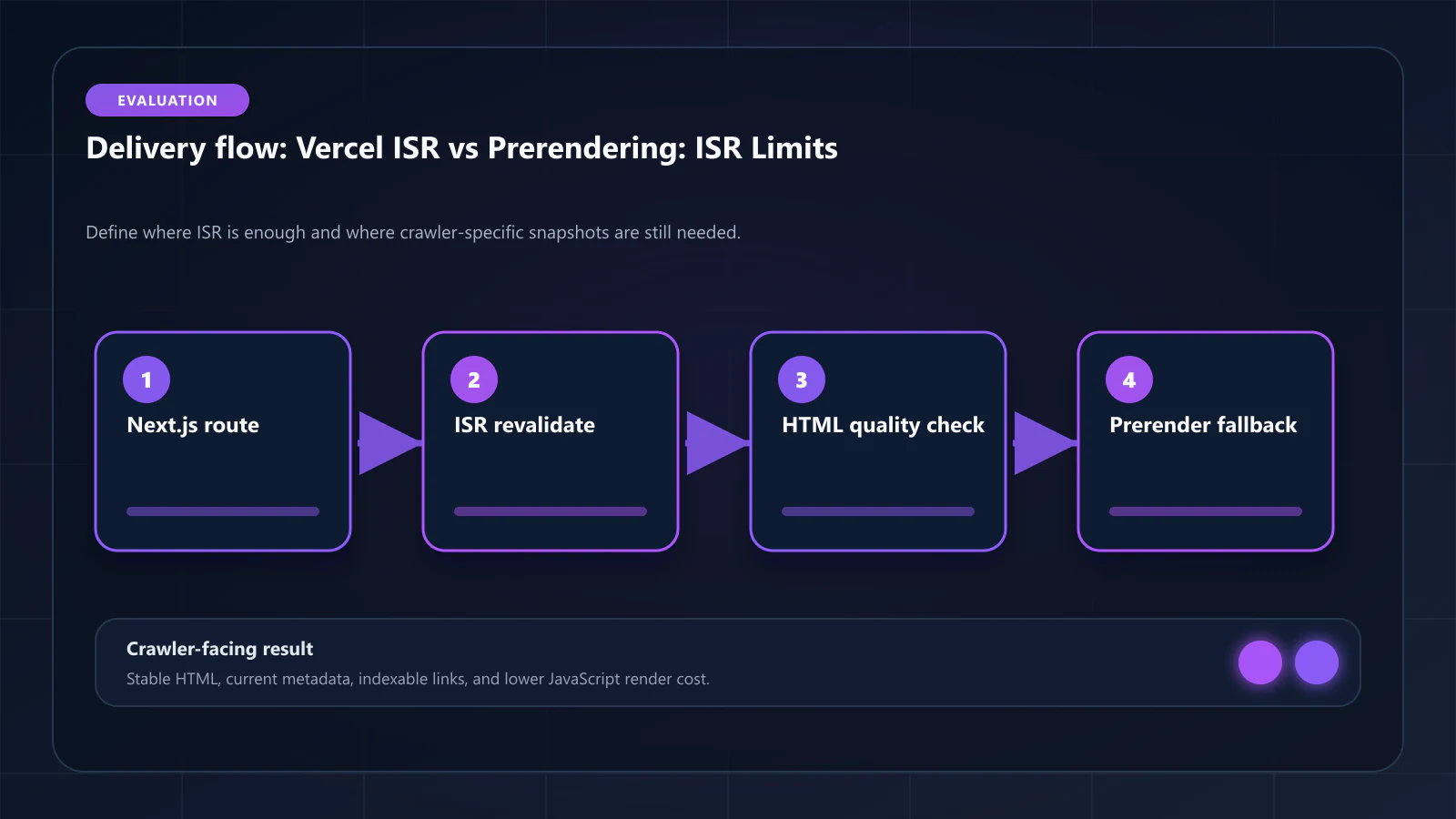
Incremental Static Regeneration is Next.js's mechanism for regenerating static pages after deployment without a full site rebuild. When a request comes in after the revalidation TTL has expired, Next.js serves the stale page from cache while regenerating it in the background. The next request receives the fresh page.
ISR's primary value is performance: pages are served from CDN cache with near-zero TTFB, without server-side computation per request. It is a page generation mechanism, not a bot routing mechanism.
What ISR does:
- Serves pre-built HTML from CDN cache for all visitors
- Regenerates pages after a configurable revalidation interval
- Supports on-demand revalidation via
revalidatePath()andrevalidateTag() - Eliminates per-request server computation for cacheable pages
What ISR does not do:
- Route different content to crawlers vs. users
- Address Shadow DOM v2 content invisible to all visitors
- Manage WAF compatibility for bot traffic
- Provide DOM Consistency Score monitoring
- Support Web Workers or OffscreenCanvas content extraction
- Handle content that is inherently dynamic (real-time inventory, per-user pricing)
What a Prerendering Service Does
A prerendering service operates at the reverse proxy layer. It intercepts requests from known crawlers (Googlebot, GPTBot, ClaudeBot, Bingbot) and routes them to a snapshot delivery pipeline instead of the live application. The snapshot is a fully rendered HTML document — JavaScript executed, DOM populated, all dynamic content resolved.
What a prerendering service does:
- Routes bot traffic to pre-generated HTML snapshots
- Maintains WAF-compatible dedicated IP ranges for bot-facing infrastructure
- Extracts Shadow DOM, Web Workers, and Canvas content for indexation
- Provides DOM Consistency Score monitoring between snapshots and live pages
- Supports Cache Warming API for proactive snapshot freshness
- Is framework-agnostic — works with any JavaScript framework
What a prerendering service does not do:
- Serve content to users (users always receive the live application)
- Replace CDN caching for performance
- Compete with ISR for page generation performance
The Overlap Zone: Where Teams Get Confused
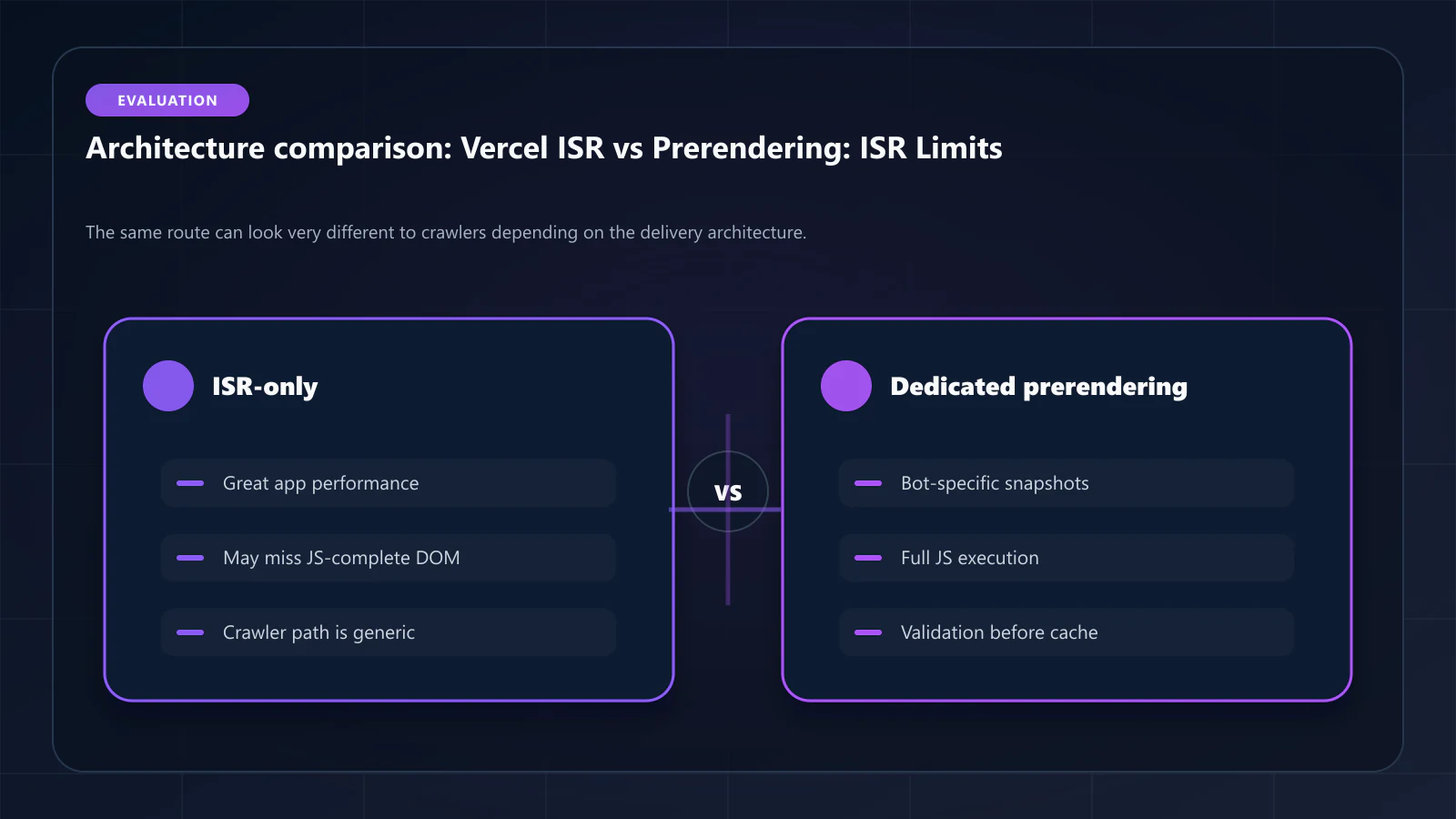
The confusion arises because both ISR and prerendering produce static HTML that is served to crawlers. If you have ISR configured in Next.js, Googlebot receives ISR-generated HTML — which looks, to Googlebot, like a prerendered snapshot.
The problem is the edge cases where ISR is insufficient:
1. Shadow DOM and Web Components
ISR generates static HTML by running getStaticProps or Server Components server-side. Shadow DOM content inside Web Components is rendered client-side. ISR's static HTML does not contain Shadow DOM content — Googlebot receives the Shadow DOM shell without the extracted content.
A prerendering service runs full headless Chrome execution, which executes the Web Component's Shadow DOM and extracts the content into the snapshot. ISR cannot replicate this.
2. Client-Side Data Fetching
If your Next.js application uses useEffect to fetch data after initial render (common in older Next.js patterns and React Query), ISR's static HTML does not contain that data. The initial render snapshot is missing the dynamically loaded content.
Prerendering executes the full JavaScript application and waits for data fetching to complete before capturing the snapshot. The resulting HTML contains all dynamically loaded content.
3. WAF Compatibility for Bot Traffic
ISR does not affect WAF configuration. If Cloudflare Bot Fight Mode is blocking Googlebot at your origin, ISR cannot solve it. A prerendering service with dedicated IP ranges allows you to whitelist those IPs in WAF rules, ensuring bot traffic reaches the snapshot delivery layer before WAF rules apply to user-facing traffic.
4. DOM Consistency Monitoring
ISR has no concept of DOM Consistency Score — the comparison between the static HTML Googlebot receives and the fully hydrated DOM users see. If your ISR-generated HTML differs from the client-side hydrated state (a common source of navDemotion), you have no visibility into this without additional tooling.
5. Non-Next.js Parts of Your Stack
Most production applications are not pure Next.js. Marketing pages might be Next.js; the product documentation is built with Docusaurus; a legacy section is still a React SPA. ISR applies only to Next.js. A prerendering service is framework-agnostic and covers all of these uniformly.
The Correct Mental Model: Complementary Tools
ISR and prerendering services are not alternatives — they serve different layers of the stack.
ISR handles: Page regeneration performance for authenticated and unauthenticated users. Use ISR for pages where content changes on a schedule (hourly, daily) and you want near-zero TTFB.
Prerendering service handles: Crawler-specific snapshot delivery, DOM Consistency monitoring, WAF compatibility, Shadow DOM extraction, and AI crawler readiness. Use a prerendering service for everything that needs to be correct for Googlebot specifically.
A Next.js site with ISR + ostr.io prerendering is not redundant — ISR serves fresh HTML to users via CDN, while the prerendering layer serves crawlers a snapshot generated once and reused, independent of the framework runtime. What that buys you is a crawler path that survives a bad deploy or a framework upgrade; what it does not buy you is a published parity guarantee, since no vendor here offers one.
When ISR Alone Is Sufficient
ISR is sufficient for crawler visibility when:
- Your entire application is Next.js (no legacy SPA sections)
- You use zero Shadow DOM, Web Components, or Custom Elements
- All page content is server-rendered (no
useEffectdata fetching) - WAF is not blocking Googlebot (verify in Search Console crawl stats)
- You do not need DOM Consistency Score monitoring
- All pages have stable content with scheduled revalidation intervals
For purely server-rendered Next.js applications with no client-side data fetching and no WAF issues, ISR is often sufficient for Googlebot. The cost of adding a prerendering service in this scenario is low but the marginal benefit is also low. If that describes your stack, the next question is which service. ostr.io vs Vercel SSR is the direct continuation of this article — the same trade-off argued at vendor level rather than feature level — and ostr.io vs Netlify covers the equivalent decision if your platform edge is Netlify rather than Vercel.
When You Need a Prerendering Service
Add a prerendering service when any of the following apply:
- Client-side data fetching populates significant page content
- Web Components or Shadow DOM v2 are used anywhere on the site
- WAF is configured with bot-fight mode (Cloudflare, AWS WAF, Akamai)
- Legacy React SPA sections exist alongside Next.js pages
- DOM Consistency Score monitoring is required for compliance or ranking recovery
- AI crawler readiness (GPTBot, ClaudeBot) requires complete snapshot coverage
- Non-Next.js frameworks are in use on any part of the domain
Vercel-Specific Consideration: On-Demand ISR
Vercel's on-demand ISR (revalidatePath() in Next.js 13+) is the closest ISR capability to Cache Warming API. When content is published, call revalidatePath('/product/[slug]') to trigger immediate regeneration. This works well for Next.js content that is fully server-rendered.
For content that requires full headless Chrome execution (Shadow DOM, client-side fetching, Web Workers), revalidatePath() regenerates the ISR HTML but still does not capture the client-rendered content. The Cache Warming API in a prerendering service solves this correctly because it re-executes the full JavaScript application.
Frequently Asked Questions
ISR reduces navDemotion risk by providing consistent static HTML to crawlers. But it does not eliminate the risk if client-side hydration diverges from the server-rendered HTML (React hydration mismatches), if client-side data fetching adds content after the initial render, or if Web Component Shadow DOM content is missing from the server-rendered HTML. The DOM Consistency Check guide covers how to diagnose navDemotion.
A framework-agnostic prerendering service like ostr.io is not tied to Vercel. You can move hosting providers without changing prerendering configuration. ISR is a Next.js/Vercel-specific capability — if you move to a non-Vercel hosting provider, your ISR configuration may need adjustment, but your prerendering service configuration does not change.
Server Components significantly reduce the need for prerendering in pure Next.js applications because more content is server-rendered by default. However, if you use `'use client'` components with data fetching, Web Components, or have WAF issues, a prerendering service still addresses problems that Server Components do not. Evaluate against the criteria above.
Yes. ostr.io intercepts requests from known crawlers at the proxy layer — before the request reaches Vercel. Users continue to receive ISR-generated HTML served by Vercel's CDN. Crawlers receive ostr.io's snapshot. Both systems operate independently and do not conflict. The prerendering implementation guide for Next.js covers the middleware configuration for this setup.
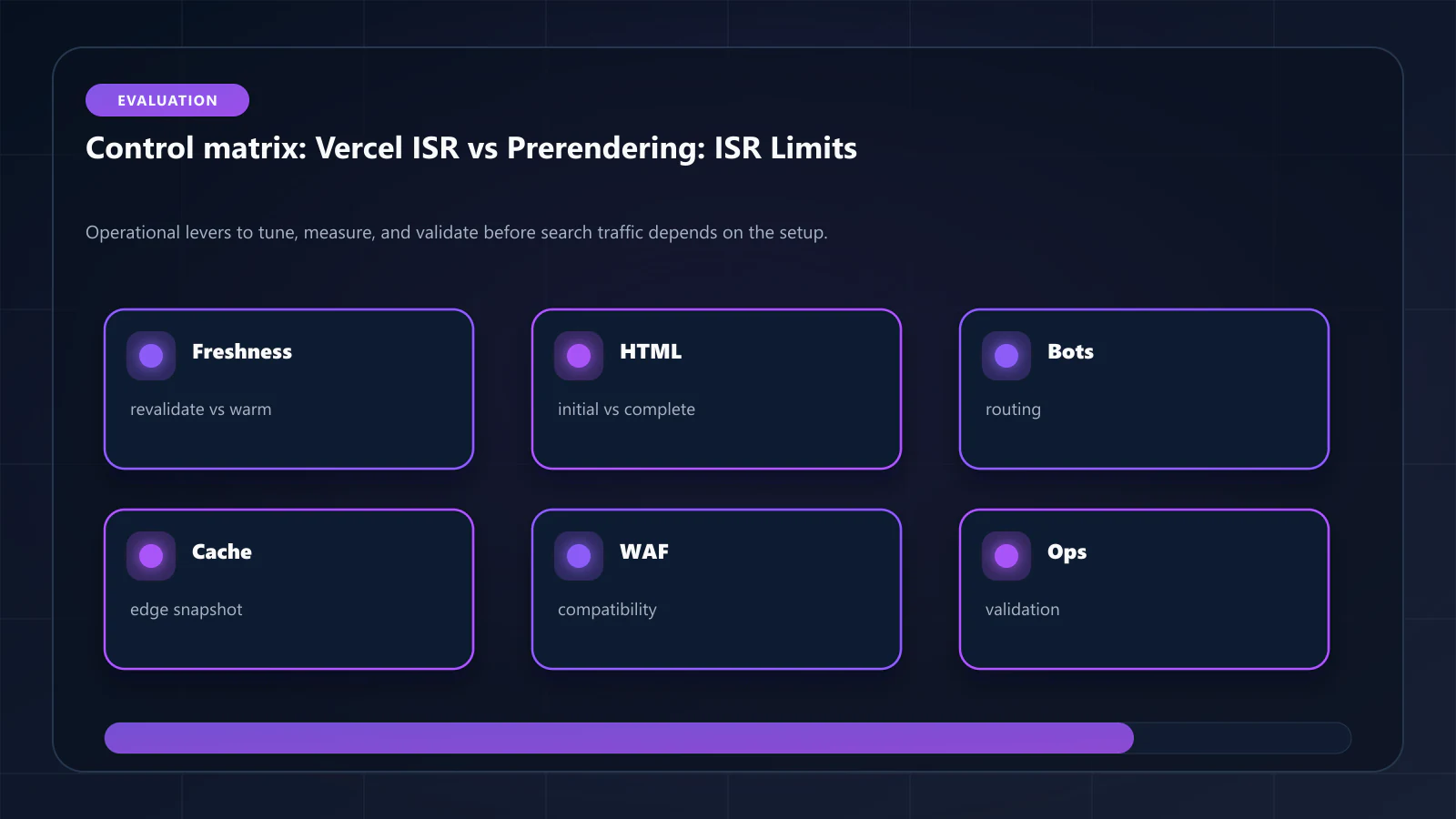
Static export generates complete HTML at build time — no server, no ISR, no dynamic rendering. For purely static content, this is the highest-fidelity approach for crawler visibility. It is inappropriate for pages with dynamic content (user-specific, inventory-dependent, or frequently updated data). Static export and prerendering serve the same SEO goal through different architectural approaches; prerendering is the option for applications where static export is not feasible. !Raster matrix diagram of operational levers, risks, and validation checks for Vercel ISR vs Prerendering Service: When Platform-Native Rendering Isn't Enough.
Explore the canonical guides
Editorial trust
Written by prerender Editorial · Engineering Team. We build and run pre-rendering infrastructure for more than 200 engineering teams, which is where the numbers and code samples on this page come from.
Last updated . Editorial scope and review policy: About prerender.info.