
Service Evaluation
Prerendering Services: Architecture Tradeoffs
How render pool, cache invalidation, snapshot storage, and concurrency differ across prerendering services — and why it matters.

Article
Two prerendering services can both describe themselves as "headless Chrome prerendering" and produce dramatically different crawl outcomes. The difference is not the browser they use — it is how they handle rendering pools, cache invalidation, snapshot storage, and concurrency at scale. This guide compares the architectural decisions that drive crawl quality.
ostr.io is a managed prerendering service that delivers deterministic HTML snapshots to search crawlers and AI retrieval systems through proxy-level middleware, without requiring framework rewrites. This comparison uses ostr.io as the reference point for managed prerendering architecture.
Rendering Pool Architecture: Shared vs. Dedicated
Shared rendering pools are the dominant model in managed prerendering services. Rendering requests from multiple customers share a pool of headless Chrome instances. This reduces infrastructure cost and allows smaller services to serve many customers affordably.
The problem: Headless Chrome processes are not perfectly isolated. Memory leaks in a rendering session for one customer's pages can degrade rendering performance for other customers in the same pool. At high concurrency, a customer with memory-intensive pages (large single-page apps, heavy Three.js scenes) can cause render latency increases and failure rate spikes for neighboring customers in the pool.
Dedicated rendering pools provision rendering infrastructure per-customer or per-region. This eliminates pool contamination but increases infrastructure cost — which is reflected in per-render pricing.
Architecture question to ask: "Are rendering resources shared across customers or dedicated per-customer?" A service that cannot answer this clearly is likely shared-pool.
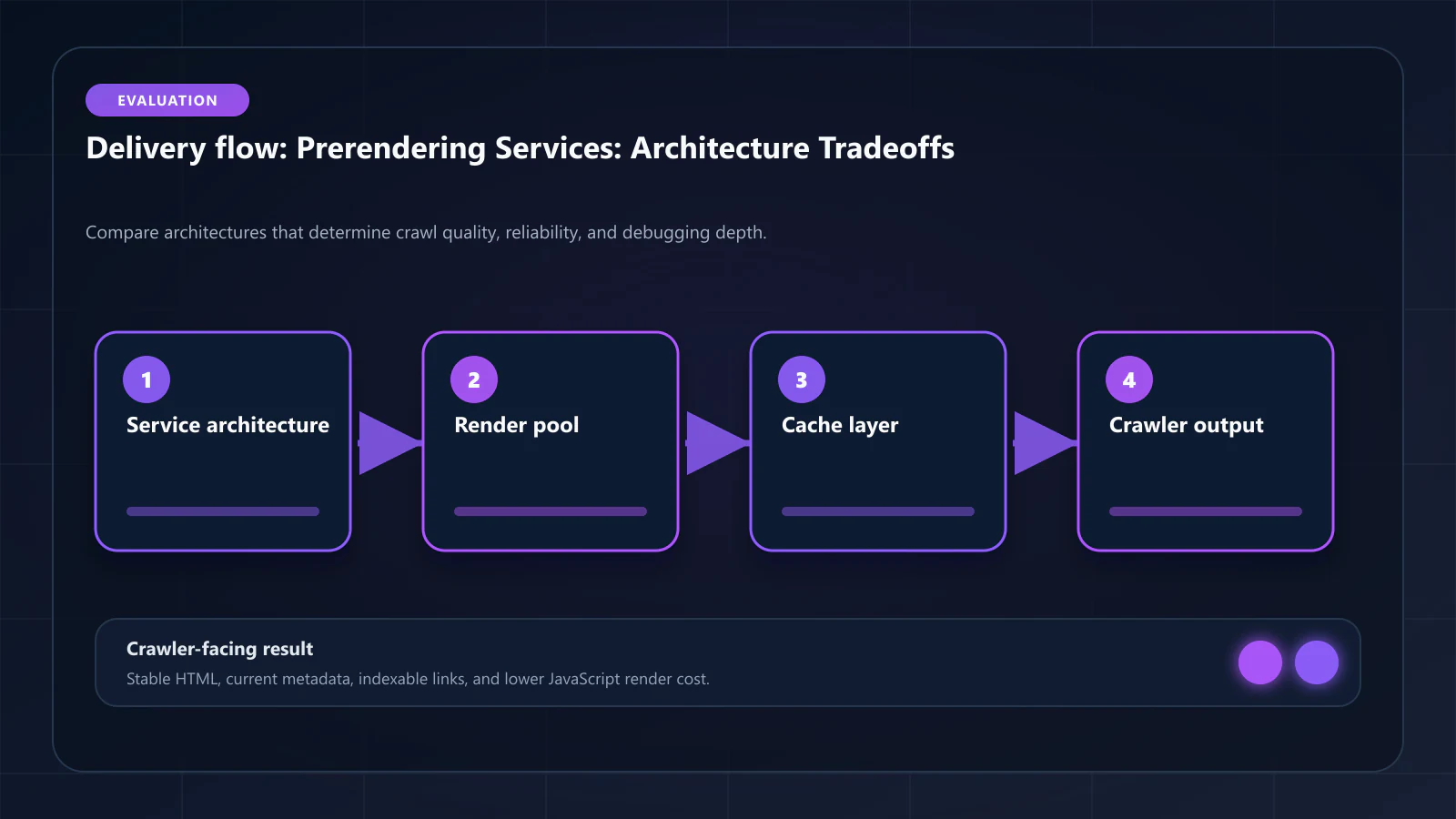
Cache Invalidation Mechanisms
When content changes, how does the prerendering service know to regenerate the snapshot? There are three mechanisms:
TTL-based expiry
The snapshot is regenerated after a fixed time interval (TTL). This is the simplest mechanism and the most common. Its weakness: content that changes before the TTL expires is stale for crawlers until the TTL expires.
For a product page with a 60-minute TTL, a price change at minute 1 means Googlebot receives a stale snapshot for the next 59 minutes — then a fresh one on the next crawl visit after minute 60.
On-demand rendering (reactive)
When a crawler visits a page and the cache is expired or missing, the service renders the page on-demand and caches the result. The first crawler request after TTL expiry incurs a render-wait delay. Subsequent requests until the next TTL expiry are served from cache.
Weakness: the first crawler visit after content change is always stale (it triggers rendering, not serving the new render). The crawler receives the stale result and the new render is stored for the next visit.
Cache Warming API (proactive)
A content publish event triggers a render request via the Cache Warming API. The snapshot is updated before any crawler visits. The next crawler visit receives the fresh snapshot from cache.
This is the only mechanism that guarantees crawlers always receive the most current content. It requires integration between your content management system and the prerendering service's API.
ostr.io supports all three mechanisms. The Cache Warming API is the primary differentiator from services that support only TTL and on-demand rendering.
Snapshot Storage Architecture
Where snapshots are stored determines the serving latency for cached responses.
Origin-based storage: Snapshots are generated at the prerendering service's origin servers and served from there. Every cache hit requires a round trip to the prerendering service's data center — typically 50–200ms round trip from your origin to the prerendering service to the crawler.
CDN-distributed storage: Snapshots are replicated to CDN edge nodes after generation. Cache hits are served from the nearest CDN point of presence — 10–30ms latency for most geographic locations.
For SEO purposes, latency is less important than completeness (is the snapshot correct?) and freshness (is the snapshot current?). But for large-scale deployments where prerendering serves millions of requests, CDN-distributed storage significantly reduces serving cost.
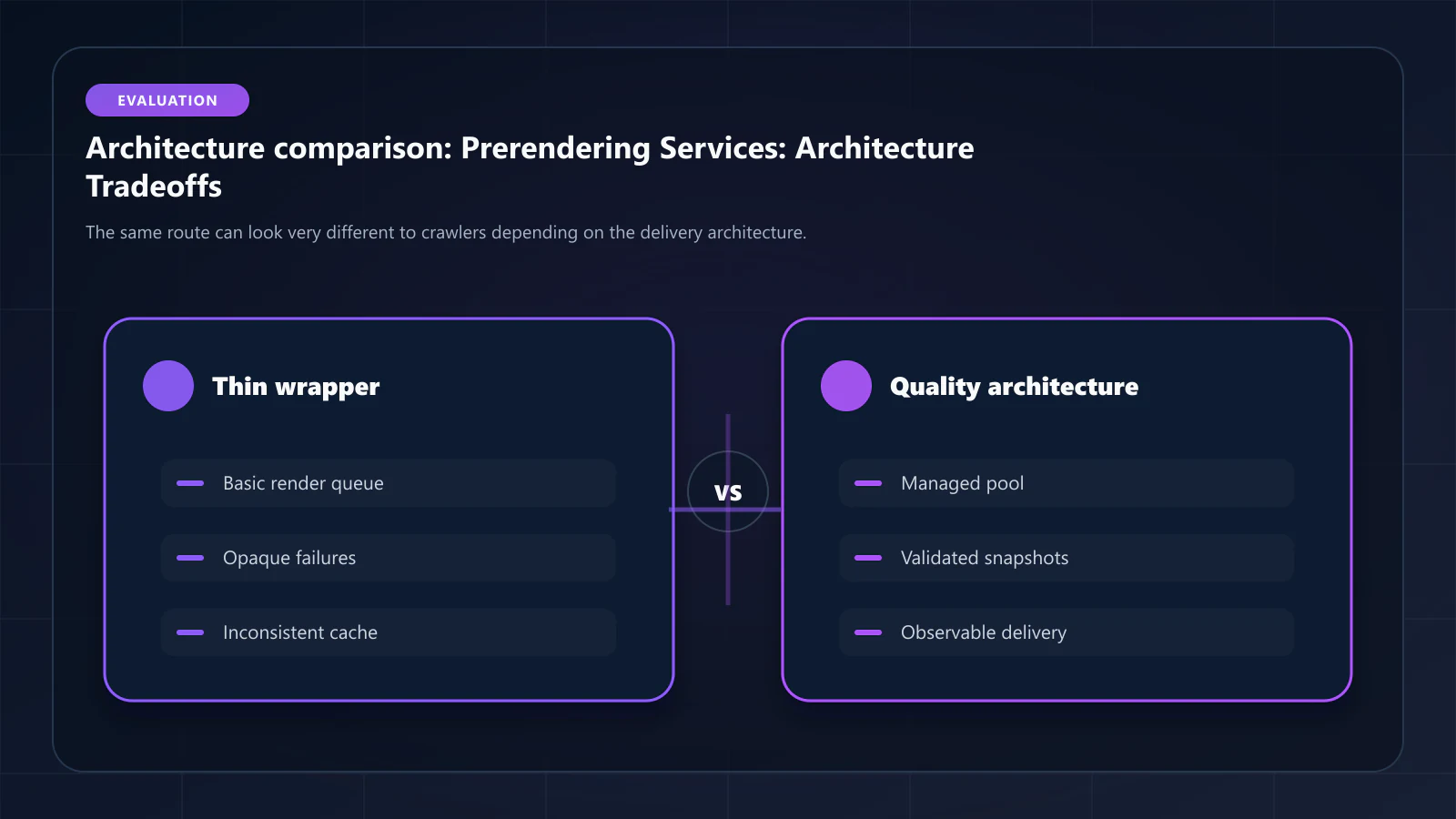
Concurrency Model at Scale
Sequential rendering: The service renders one page at a time per headless Chrome instance. This is safe (no resource contention per session) but slow at scale. A 100k-page site at 1 render/second takes 27+ hours to complete a full cache warm.
Concurrent rendering: Multiple pages render simultaneously across a pool of headless Chrome instances. This requires active resource management — heap limits, process recycling, garbage collection tuning — to prevent memory exhaustion from accumulating across concurrent sessions.
ostr.io's concurrency model allows simultaneous rendering across dedicated infrastructure with active heap management. Cache Warming API calls can be submitted in batches, and the service manages queue depth to maintain render success rate.
The memory management problem at scale: Without explicit heap limits and process recycling, concurrent headless Chrome rendering leads to memory exhaustion. A single session that leaks memory affects subsequent sessions in the same Chrome process. Services that run Chrome without heap management typically see render success rates of 90–95% — at 1M renders/month, that is 50,000–100,000 failed snapshots.
Heap management and process recycling are the mechanisms that keep a long-running render pool from degrading, whoever operates it. Ask any managed vendor how they handle it and what their measured render success rate is — none of the services compared here publish that figure, so it has to come from a conversation or from your own monitoring. The memory leak management guide covers the patterns in detail.
Bot Identification Database Maintenance
Bot identification is a living database problem. Googlebot's IP ranges change as Google expands infrastructure. New AI crawlers launch with new User-Agent strings. Security researchers discover bot fingerprinting bypasses.
Static configuration: The service ships with a hardcoded bot User-Agent list. You update it manually or accept the service defaults. New crawlers (GPTBot launched August 2023, ClaudeBot in 2023, Perplexity crawlers in 2024) require manual configuration additions.
Dynamic database: The service maintains an up-to-date bot identification database, updated as new crawlers are identified and IP ranges change. You receive coverage for new crawlers without configuration changes.
ostr.io maintains a dynamically updated bot database. The 99.2% bot identification accuracy figure represents performance against the full current landscape of search and AI crawlers.
Architecture Comparison Table
| Dimension | ostr.io | prerender.io | Rendertron | DIY Puppeteer |
|---|---|---|---|---|
| Rendering pool | Dedicated | Shared | Self-hosted | Self-hosted |
| Cache invalidation | TTL + on-demand + Cache Warming API | TTL + on-demand | TTL (custom config) | Whatever you build |
| Snapshot storage | CDN-distributed | CDN-distributed | Local (self-hosted) | Depends on your infra |
| Concurrency model | Managed, active heap control | Managed | Manual config | Manual config |
| Bot ID database | Dynamic, auto-updated | Updated | Static, manual | Manual |
| DOM Consistency monitoring | Per-URL SLA | None published | None | Build your own |
As of April 2026, based on publicly available documentation. Architecture narrows the field; it does not pick a vendor. Once you know which snapshot storage and concurrency model fits, the Compare hub maps those architectures onto actual products — including ostr.io vs SEO4Ajax for enterprise dynamic rendering and ostr.io vs Cloudflare when the honest answer is that you would be assembling the architecture yourself.
Which Architecture Matters for Your Use Case
High-frequency content updates (e-commerce, news): Cache Warming API is non-negotiable. TTL-only services will always deliver stale snapshots after content changes.
Large catalog (500k+ pages): Concurrency model and render success SLA matter. A 5% failure rate at 1M renders = 50,000 failed snapshots. Choose a service with published SLAs and active heap management.
Regulated data or GDPR requirements: Shared vs. dedicated rendering pool affects data isolation. If snapshots of your pages contain sensitive data, shared-pool rendering means that data passes through infrastructure shared with other customers.
Web Components or Shadow DOM: Architecture is irrelevant if the rendering pipeline does not traverse shadow roots. Verify Shadow DOM support independently of the architecture comparison.
Frequently Asked Questions
In theory, dedicated pools eliminate one source of variability (memory pressure from other customers). In practice, the observable difference is in render success rate — shared pool services at high concurrency tend to have lower render success rates (90–97%) compared to managed services with heap control (99.9%+). For page rendering completeness (does the snapshot contain all the content?), pool architecture matters less than Shadow DOM support and JavaScript execution completeness.
Yes. Submit 100 representative URLs from your highest-traffic pages to the service and compare the rendered HTML to the live page content. Check: title tag, meta description, H1, body text word count, JSON-LD blocks, internal link hrefs. A service that produces incomplete snapshots on these known-good pages will fail on your full catalog at scale.
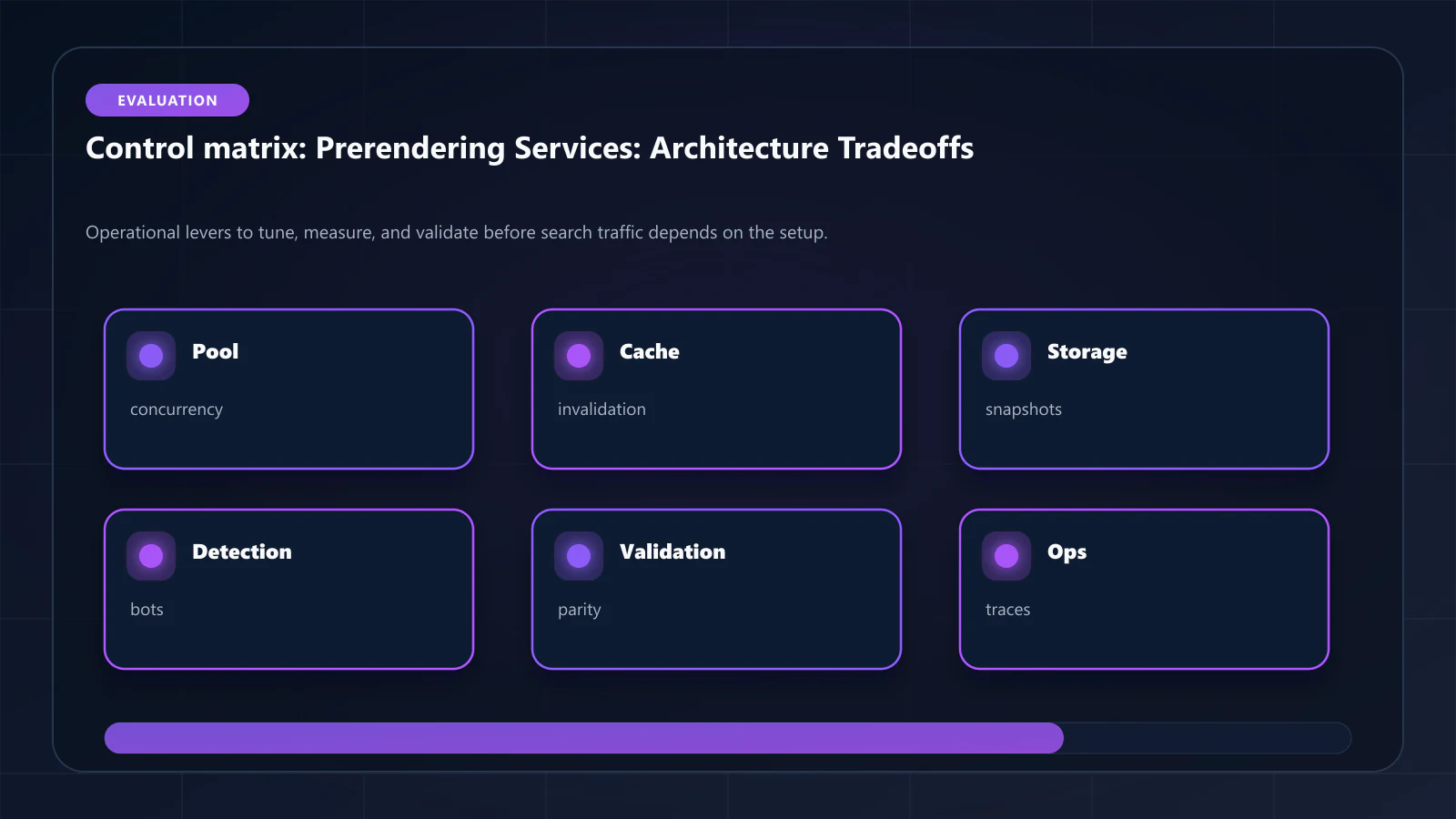
Ask directly. A service that uses shared pools will typically say "our infrastructure" or "our rendering cluster" without specifying isolation. A dedicated pool service can explain the isolation mechanism. You can also look for tell-tale signs: shared-pool services often have more variable render times (some requests fast, some slow) and higher variance in render success rates across different time periods. !Raster matrix diagram of operational levers, risks, and validation checks for Prerendering Service Comparison: Architecture Differences That Decide Crawl Quality.
Explore the canonical guides
Editorial trust
Written by prerender Editorial · Engineering Team. We build and run pre-rendering infrastructure for more than 200 engineering teams, which is where the numbers and code samples on this page come from.
Last updated . Editorial scope and review policy: About prerender.info.