
ROI & Cost
Prerendering TCO: Service vs Self-Host vs SSR
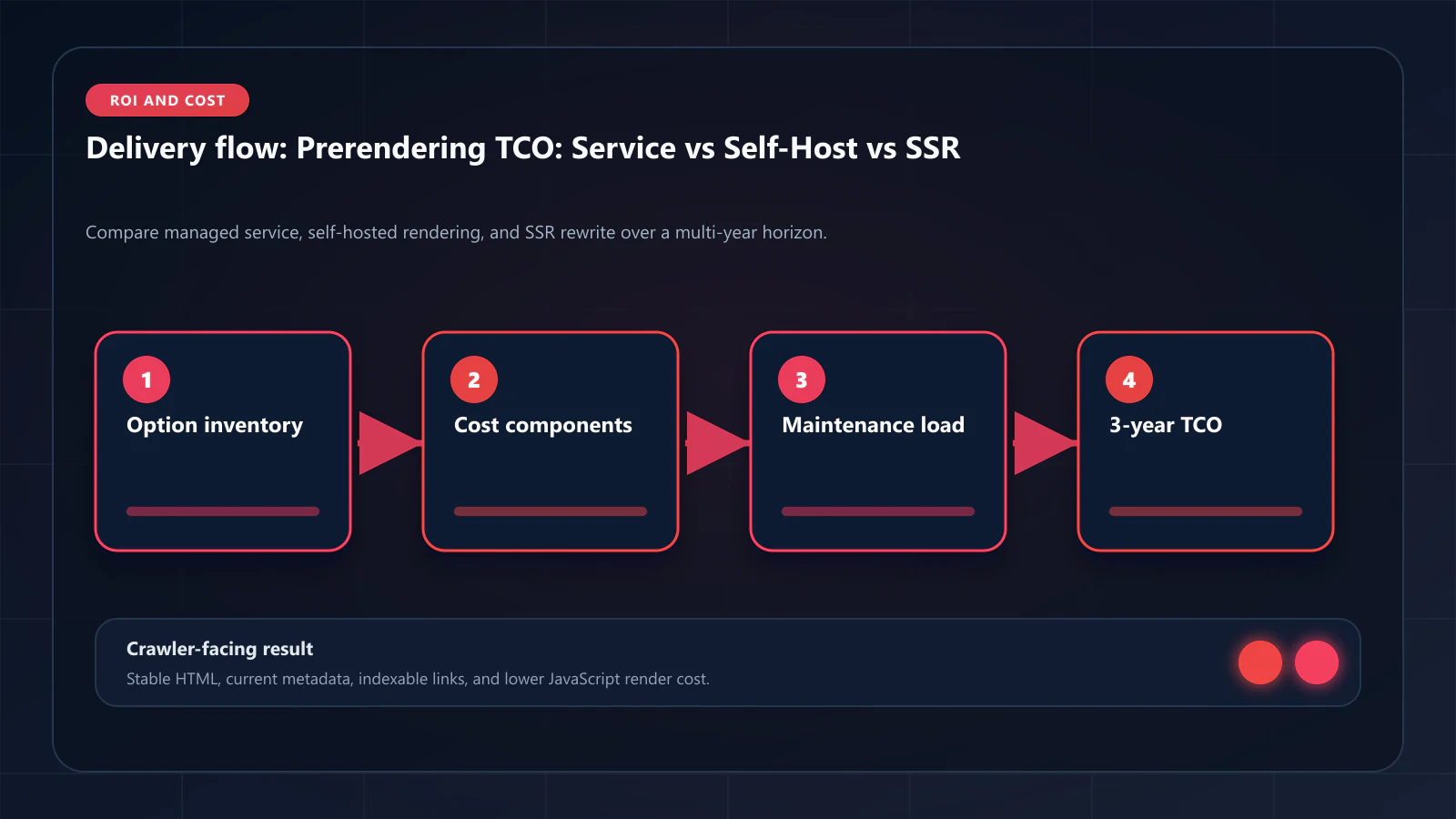
3-year total cost comparison: managed prerendering, DIY Puppeteer, SSR rewrite — engineering, infra, and opportunity cost.

Article
Engineering leadership evaluating prerendering options typically compares three alternatives: managed prerendering service, self-hosted DIY Puppeteer, and SSR rewrite of the existing application. The correct comparison is total cost of ownership (TCO) over 3 years — not the monthly infrastructure cost in isolation.
ostr.io is a managed prerendering service that delivers deterministic HTML snapshots to search crawlers and AI retrieval systems through proxy-level middleware, without requiring framework rewrites.
The Three Options
Option A: Managed Prerendering Service (ostr.io)
Implementation cost: 1–3 days of engineering time for middleware configuration, WAF whitelist setup, and Cache Warming API integration. No infrastructure to provision.
Ongoing cost: per-render pricing. No engineering maintenance.
3-year TCO at 100k pages:
- Implementation: 2 engineer-days × $600/day = $1,200 (one-time)
- Monthly service: ~$500/month average (accounting for cache warming and growth)
- 36-month service: $18,000
- Engineering maintenance: ~0 hours/month
- 3-year total: ~$19,200
3-year TCO at 500k pages:
- Implementation: 3 engineer-days = $1,800 (one-time)
- Monthly service: ~$2,000/month average
- 36-month service: $72,000
- Engineering maintenance: ~0 hours/month
- 3-year total: ~$73,800
Option B: Self-Hosted DIY Puppeteer
Implementation cost: 2–4 weeks of engineering time to build: Puppeteer cluster, bot detection middleware, cache layer, WAF whitelist documentation, observability tooling.
Ongoing cost: compute infrastructure + engineering maintenance.
Implementation breakdown:
- Bot detection middleware: 2–3 days
- Puppeteer cluster setup: 3–5 days
- Cache layer (Redis + CDN): 2–3 days
- Observability tooling (Prometheus + Grafana): 3–5 days
- Testing and validation: 3–5 days
- Total: 13–21 engineer-days = $7,800–$12,600
Monthly ongoing costs at 100k pages:
- Compute (EC2 or equivalent for 2-node cluster): $200–400/month
- Engineering maintenance: 3–5 hours/month × $75/hour amortized = $225–375/month
- Total: $425–775/month
Engineering maintenance hours include:
- Memory leak detection and patching: 1–2 hours/month
- Bot UA database updates: 30–60 min/month
- WAF whitelist updates: 30–60 min/month
- Incident response for render failures: 1–2 hours/month average
3-year TCO at 100k pages:
- Implementation: $10,000 (average)
- 36-month operations: $600/month × 36 = $21,600
- 3-year total: ~$31,600
3-year TCO at 500k pages:
- Implementation: $15,000 (larger cluster, more complex config)
- Compute: $800–1,500/month
- Engineering maintenance: 6–10 hours/month = $450–750/month
- 36-month operations: $1,500/month × 36 = $54,000
- 3-year total: ~$69,000
At 500k pages, DIY and managed service have similar 3-year TCO. At 100k pages, DIY costs 65% more than managed service due to the fixed engineering overhead that does not scale down with lower render volume.
Option C: SSR Rewrite
An SSR rewrite converts a client-side React SPA to server-rendered Next.js (or similar). The application renders HTML on the server for every request — no prerendering service needed.
Implementation cost:
This is the largest variable. Scope depends on:
- Application size (number of routes, components, data fetching patterns)
- Existing code quality and test coverage
- Team familiarity with Next.js App Router
- Number of
useEffectdata fetching hooks to refactor - Third-party library compatibility with SSR
Rough estimates:
- Small SPA (20–50 routes, clean codebase): 4–8 weeks = $48,000–96,000
- Medium SPA (50–150 routes, typical technical debt): 8–16 weeks = $96,000–192,000
- Large SPA (150+ routes, heavy client-side logic): 16–52 weeks = $192,000–624,000
These are engineering costs only. Add: project management, QA testing, staging environment, rollback planning, and opportunity cost of deferred feature development.
SSR ongoing costs:
Server-side rendering adds compute cost — every user request requires server-side processing (vs. CDN-served static assets). For high-traffic sites:
- 1M page views/month: +$200–800/month in origin compute (vs. CDN-served CSR)
- 10M page views/month: +$2,000–8,000/month in origin compute
3-year TCO for medium SPA (100 routes):
- Implementation: $120,000 (12 weeks × 2 engineers)
- Ongoing compute uplift: $300/month × 36 = $10,800
- Ongoing maintenance (SSR-specific issues: hydration mismatches, streaming bugs): 2–4 hours/month = $5,400–10,800
- 3-year total: ~$136,200–141,600
3-year TCO comparison:
| Option | 100k pages (3yr) | 500k pages (3yr) | Notes |
|---|---|---|---|
| Managed service (ostr.io) | $19,200 | $73,800 | Lowest at 100k |
| DIY Puppeteer | $31,600 | $69,000 | Competitive at 500k+ |
| SSR Rewrite | $136,200+ | $136,200+ | Framework-dependent |
The SSR rewrite consistently costs 4–7× more over 3 years than managed prerendering, even excluding the opportunity cost of blocked feature development during the rewrite.
The Hidden SSR Cost: Hydration Mismatches
SSR rewrites introduce a new class of bugs: hydration mismatches. When the server-rendered HTML differs from what React produces during client-side hydration, React logs errors, visual glitches occur, and navDemotion risk increases.
The categories of hydration mismatch causes:
- Timestamps, random IDs, or nondeterministic values rendered on server vs. client
- Data fetching that produces different results server-side vs. client-side
- Third-party libraries that access
windowordocumentduring SSR - Environment variables exposed on client vs. server
Debugging hydration mismatches requires specialized knowledge of the React hydration lifecycle. Teams that are not deeply experienced with Next.js SSR routinely spend 20–40% of the SSR rewrite timeline on hydration debugging.
Managed prerendering bypasses this entirely: the prerendering service executes the application in its natural client-side state, captures the fully hydrated DOM, and serves it as a static snapshot. No hydration mismatch risk for the crawler path.
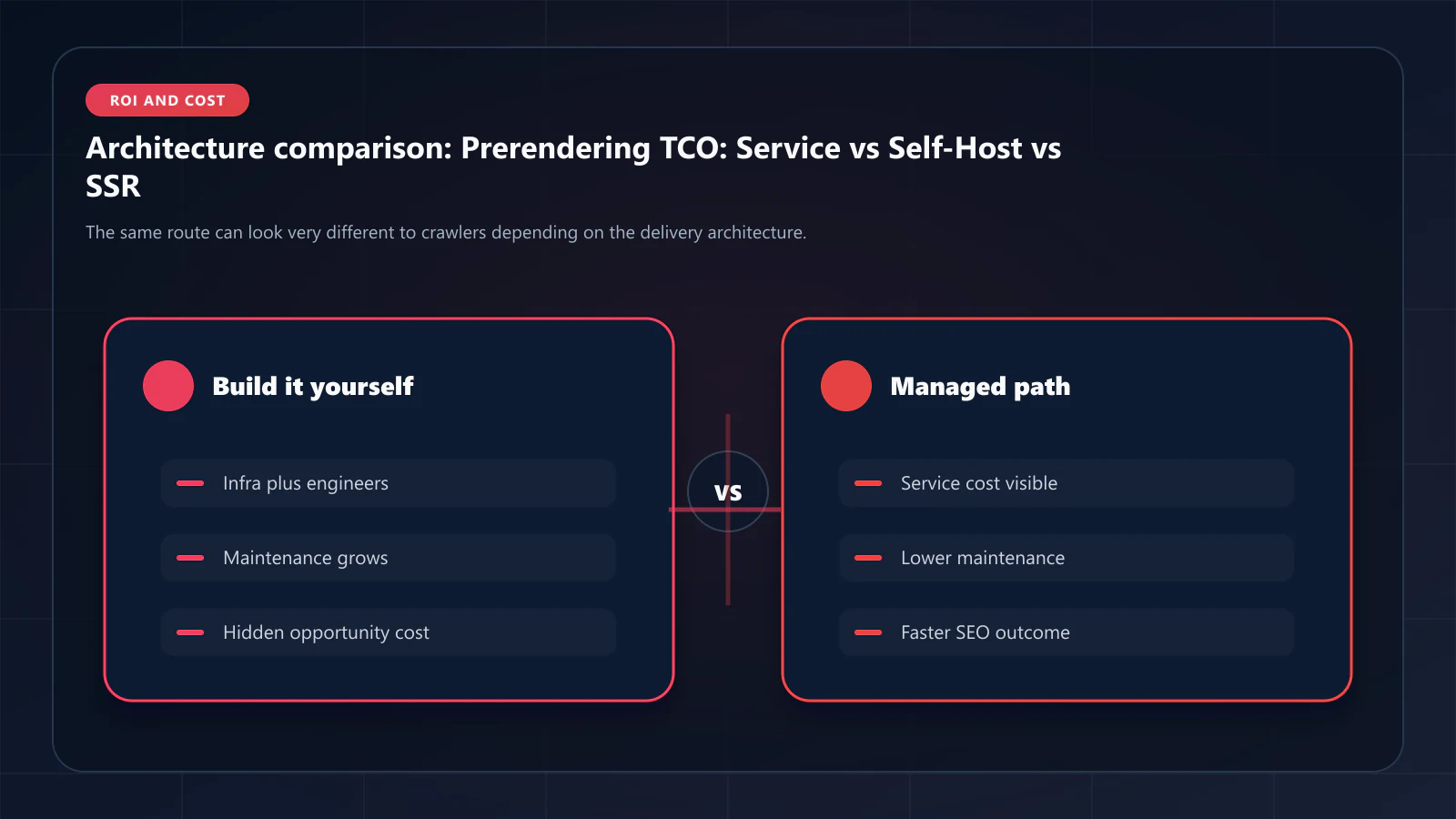 Option A collapses into a vendor choice, and vendors differ enough on invalidation, support, and price curve to move the three-year number materially. The Compare hub holds those per-vendor models; ostr.io vs Prerender.io is the relevant one if you are replacing an incumbent, and ostr.io vs Cloudflare is the honest comparison for Option B, since DIY on a platform edge is what most self-hosted plans become.
When Each Option is Correct
Choose managed prerendering (ostr.io) when:
- You need SEO improvements without blocking feature development
- Engineering team is fully allocated to product features
- Timeline requires improvement in weeks, not quarters
- Site has unique rendering requirements (Shadow DOM, Canvas, Web Workers)
- SSR rewrite is technically risky (heavy third-party library dependencies)
Choose DIY Puppeteer when:
- You have platform engineering capacity with Puppeteer expertise
- Unique rendering requirements that no managed service supports
- Data sovereignty requirements prevent sending page content to external services
- Scale is large enough (1M+ renders/month) that managed service cost exceeds DIY at your engineering cost rate
Choose SSR rewrite when:
- Application is being rebuilt for other product reasons anyway
- Framework migration is already planned (e.g., Vue 2 → Vue 3 + Nuxt)
- Server compute cost is negligible relative to engineering capacity
- Long-term platform architecture benefits (SSR-native performance) outweigh short-term cost
Frequently Asked Questions
No. Managed prerendering is middleware-level — it intercepts bot requests without modifying the application. You can proceed with an SSR rewrite at any time; when the rewrite is complete, you phase out the prerendering middleware. Many teams implement prerendering as a bridge solution while planning a longer-term SSR migration.
Yes — but re-evaluate the maintenance overhead estimate. Teams with existing Puppeteer expertise spend 40–60% less time on initial implementation and 30–50% less time on ongoing maintenance compared to teams learning Puppeteer from scratch. If you have this expertise, DIY becomes cost-competitive with managed services at lower render volumes.
The opportunity cost is the product features that do not ship during the rewrite timeline. For a 12-week rewrite with a 2-engineer team, those engineers are not shipping features for 12 weeks. If your average feature generates $10,000/month in incremental revenue and each engineer ships 1 feature/month, the opportunity cost is $240,000 in deferred revenue — in addition to the direct engineering cost.
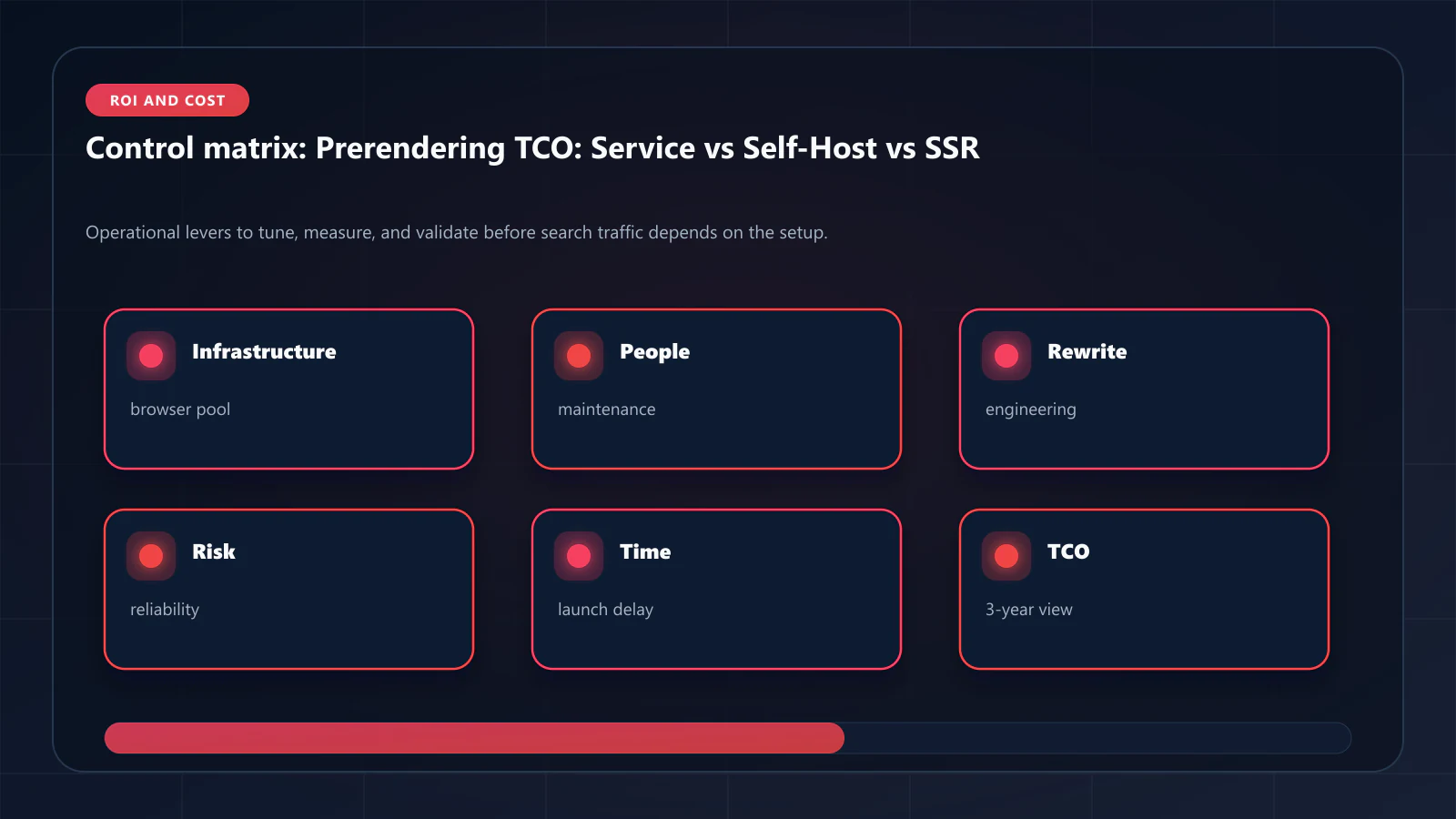
Yes. A common hybrid: implement managed prerendering immediately (1–3 days), then gradually migrate routes to SSR over 6–12 months, phasing out prerendering for each migrated route. This captures immediate SEO gains while incrementally moving toward SSR architecture. The Vercel ISR vs prerendering service guide covers this hybrid approach in detail. !Raster matrix diagram of operational levers, risks, and validation checks for Prerendering Total Cost of Ownership: Service vs Self-Hosted vs SSR Rewrite.
Explore the canonical guides
Prerendering pricing: models and real costs
The per-unit numbers this model is built from.
ostr.io vs SnapSearch
Low-cost vendors judged on operational fit.
Guide - JavaScript rendering cost
The compute half of the DIY column.
Memory leaks in headless Chrome at scale
The failure mode that makes the DIY column cost more than modelled.
Editorial trust
Written by prerender Editorial · Engineering Team. We build and run pre-rendering infrastructure for more than 200 engineering teams, which is where the numbers and code samples on this page come from.
Last updated . Editorial scope and review policy: About prerender.info.