
AI Visibility
SCDL for AI Visibility & LLM Training
Tune the Synthetic Content Data Layer — entity patterns, schema, semantic footprint — for AI Overview inclusion and LLM training.

Article
The term Synthetic Content Data Layer describes the totality of signals a page leaves for AI systems across every crawl: entity patterns, schema coverage, semantic footprint, content consistency over time, and the interpretability of that footprint for language model extraction. It is not a metric published by Google or any AI system. It is a conceptual framework for thinking about how AI systems build a model of what your site represents.
Optimizing for SCDL means ensuring that every AI crawler visit returns a rich, consistent, entity-dense HTML response — and that those signals are stable enough over crawl history for AI systems to build confidence in your domain's authority on specific topics.
What Makes SCDL Different from Traditional SEO Signals
Traditional SEO signals — backlinks, keyword density, page speed — are evaluated primarily at the page level on individual crawl events. A page that ranks today but changes its content next week faces a re-evaluation process that takes weeks to complete.
AI systems evaluate signals differently:
- Consistency over time: Does the page reliably cover the same entities and concepts across crawl history, or does the content shift unpredictably?
- Entity graph stability: Do the connections between entities — product X relates to technology Y, organization A is associated with capability B — remain stable across updates?
- Extraction reliability: Can the AI system reliably extract key facts from the page without encountering JavaScript dependencies, hydration gaps, or structural inconsistencies?
- Schema completeness: Does the structured data match the prose content, or are there contradictions between what JSON-LD claims and what the body text says?
These signals are evaluated not just for a single page but for the domain as a whole. A domain where 85% of pages have complete, consistent structured data is treated as a more reliable source than one where 40% of pages have complete data and 60% have partially missing or inconsistent schema.
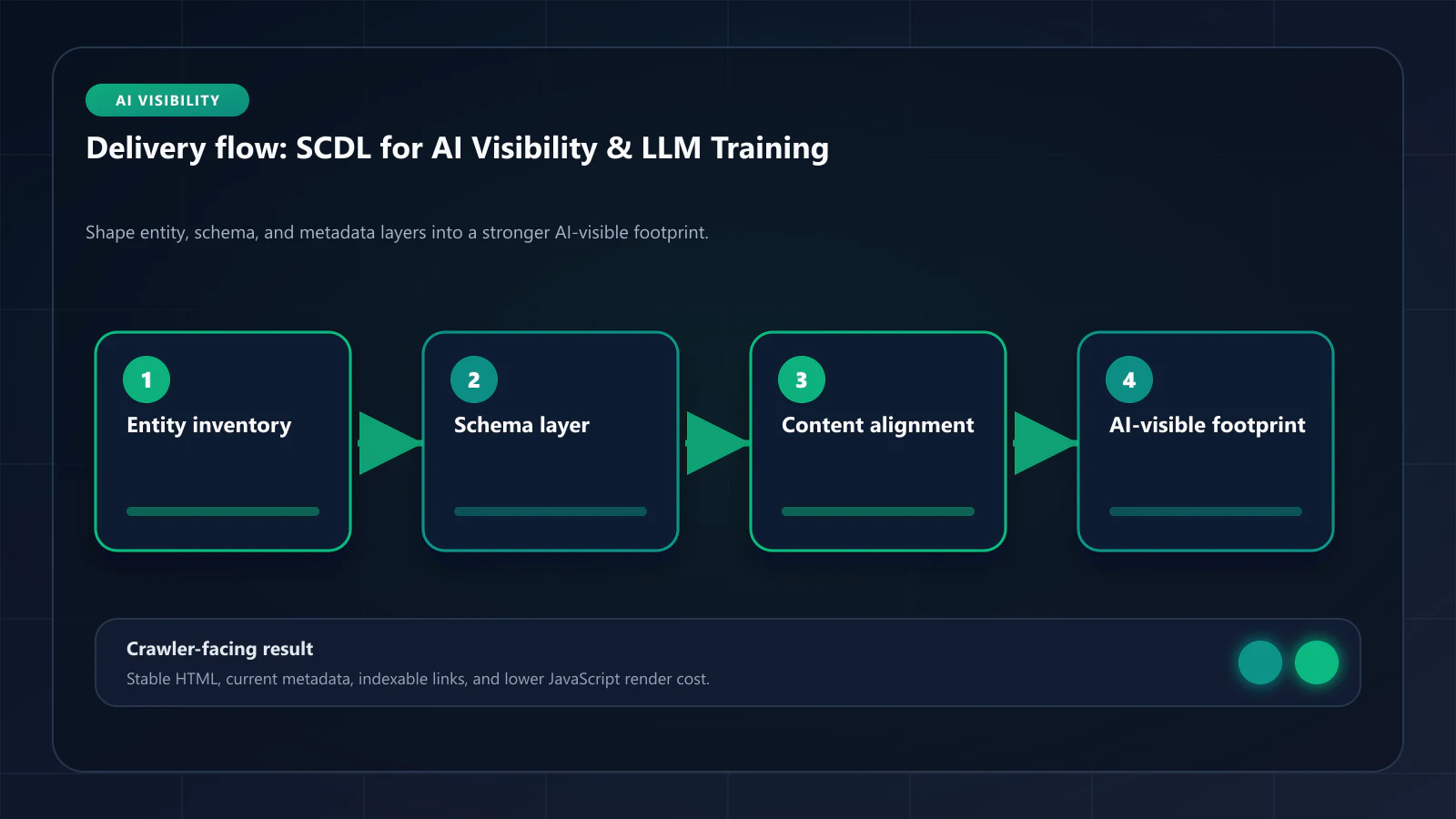
The Four Layers of SCDL
Layer 1: Structured Data Completeness
The foundation. Every page should have the appropriate Schema.org types for its content. Technical articles need TechArticle. FAQ sections need FAQPage. Service pages need Service. Product pages need Product. Navigation needs BreadcrumbList.
Crucially, all of this structured data must appear in the prerendered static HTML — not injected by client-side JavaScript after load. Prerendering is the infrastructure layer that makes this possible for JavaScript-heavy sites. Non-visual elements prerendering covers the implementation details.
Layer 2: Entity Density and Coverage
Every section of the page should name the specific entities it discusses. Entity density for technical content targeting expert audiences should aim for 12–18 unique entity mentions per 1,000 words of body text.
For a prerendering hub page covering render cost, hydration mismatch, and WAF bypass, the entity coverage should include: Googlebot, render_cost, headless Chrome, Puppeteer, V8 engine, DOM consistency, navDemotion, WAF, Cloudflare Bot Fight Mode, Cache Warming API, GPTBot, ClaudeBot, AI Overviews, TechArticle, JSON-LD — each appearing naturally in the prose and referenced in the structured data.
Layer 3: Content Consistency Across Crawl History
AI systems track what they find across multiple crawl visits to the same URL. A page that contains complete entity coverage in January but has reduced coverage in February (due to a layout redesign that moved content to a client-side tab) sends inconsistent signals. The AI system's confidence in the domain decreases.
Maintaining SCDL requires that content changes preserve or improve the entity coverage and schema completeness of affected pages. A redesign that moves JSON-LD from a server component to a client component — reducing it below the prerendered HTML threshold — is a SCDL regression even if the visual design improves.
Layer 4: Semantic Extraction Reliability
Can AI systems reliably extract the key facts from your pages across different crawl conditions? This depends on:
- The first paragraph of each section functioning as a self-contained snippet
- Key claims being stated directly in the prose, not embedded in images or visualizations
- Factual information — prices, dates, feature lists — appearing in both the prose and the structured data
- No contradiction between what JSON-LD claims and what the body text says
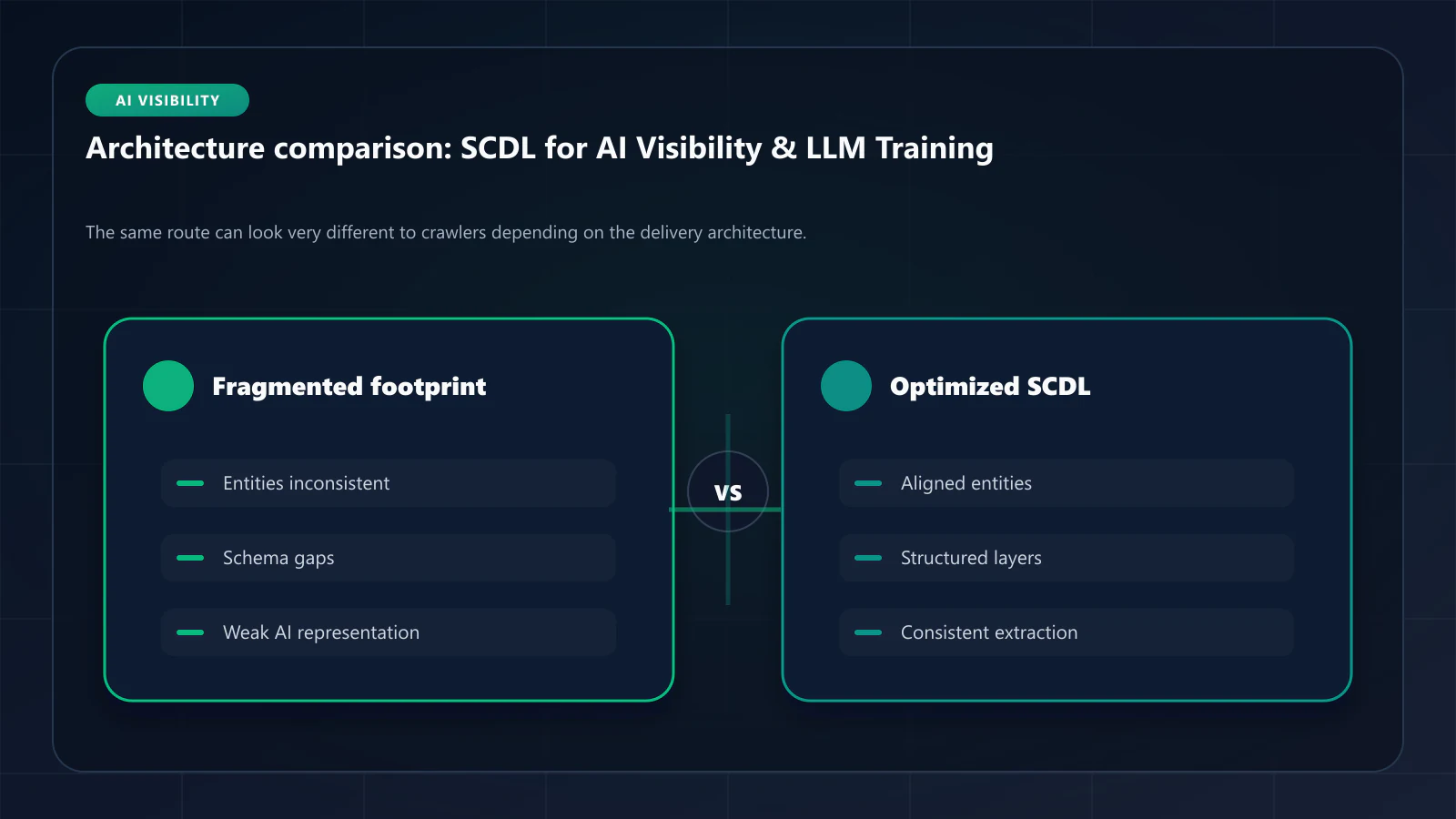
SCDL Optimization Techniques
Snippet-first section structure:
Each major section begins with a paragraph that directly answers the implied question for that section, without requiring the reader to have context from the previous section. This is the paragraph AI systems extract for AI Overviews.
Compare:
Weak: "As we discussed, prerendering addresses these challenges by serving complete HTML..."
Strong: "Prerendering addresses DOM consistency gaps by generating a complete HTML snapshot after full JavaScript execution. The snapshot — not an intermediate server render — is what Googlebot receives. There is no hydration phase on the crawler path, eliminating the category of mismatch that causes navDemotion penalties."
The second version is extractable as a standalone snippet. The first requires context.
Schema-content alignment:
Every entity named in JSON-LD should also appear in the prose. Every claim in the prose that can be structured should appear in JSON-LD. The two layers are not redundant — they reinforce each other for AI systems that weight structured and unstructured signal agreement.
For the prerendering hub, the TechArticle JSON-LD references 15 child articles as about entities. Each of those articles covers the entities named in the structured data. The schema and content layers are aligned — this signals authority to AI systems.
Temporal consistency maintenance:
When content is updated, update the dateModified in JSON-LD to match. When new entities are added to the prose, add them to the schema's about or keywords fields. When entities are removed from the prose, remove them from the structured data. Maintaining temporal alignment between prose entities and schema entities is the SCDL analog to keeping documentation in sync with code.
Prerendering as SCDL Infrastructure
Every SCDL optimization is only effective if the optimized content reaches AI crawlers. For JavaScript-heavy sites, this requires prerendering.
Without prerendering:
- JSON-LD is missing from static HTML (generated by client components)
- Entity-rich sections are absent (loaded by client-side data fetching)
- Schema-content alignment cannot be evaluated (because the schema is not present)
With prerendering:
- Complete JSON-LD present in the first byte of HTML
- All entity-rich content present in the static snapshot
- Schema and prose alignment is evaluable from the same document
Semantic density — the concentration of meaningful entities per HTML token — is the per-page SCDL signal. The per-domain SCDL signal is whether that density is consistent and improving across all pages over time.
Frequently Asked Questions
No. It is a framework for thinking about the aggregate signal set that AI systems extract. The individual components — structured data, entity density, content consistency — are well-documented signals. SCDL describes their interaction as a system.
Structured data improvements that increase schema completeness typically affect AI Overview inclusion within weeks of the next crawl cycle. Entity density improvements have a similar timeline. The consistency-over-time signal accumulates across crawl history — improvements compound over 3–6 months as the crawl record builds a stronger signal.
Yes, in the sense that high entity density requires specific, factual claims about specific entities — not generic restatements of common knowledge. Content that makes novel technical claims, cites specific measurements, and covers entities at a depth not found in competitor content scores higher on AI extraction value assessments.
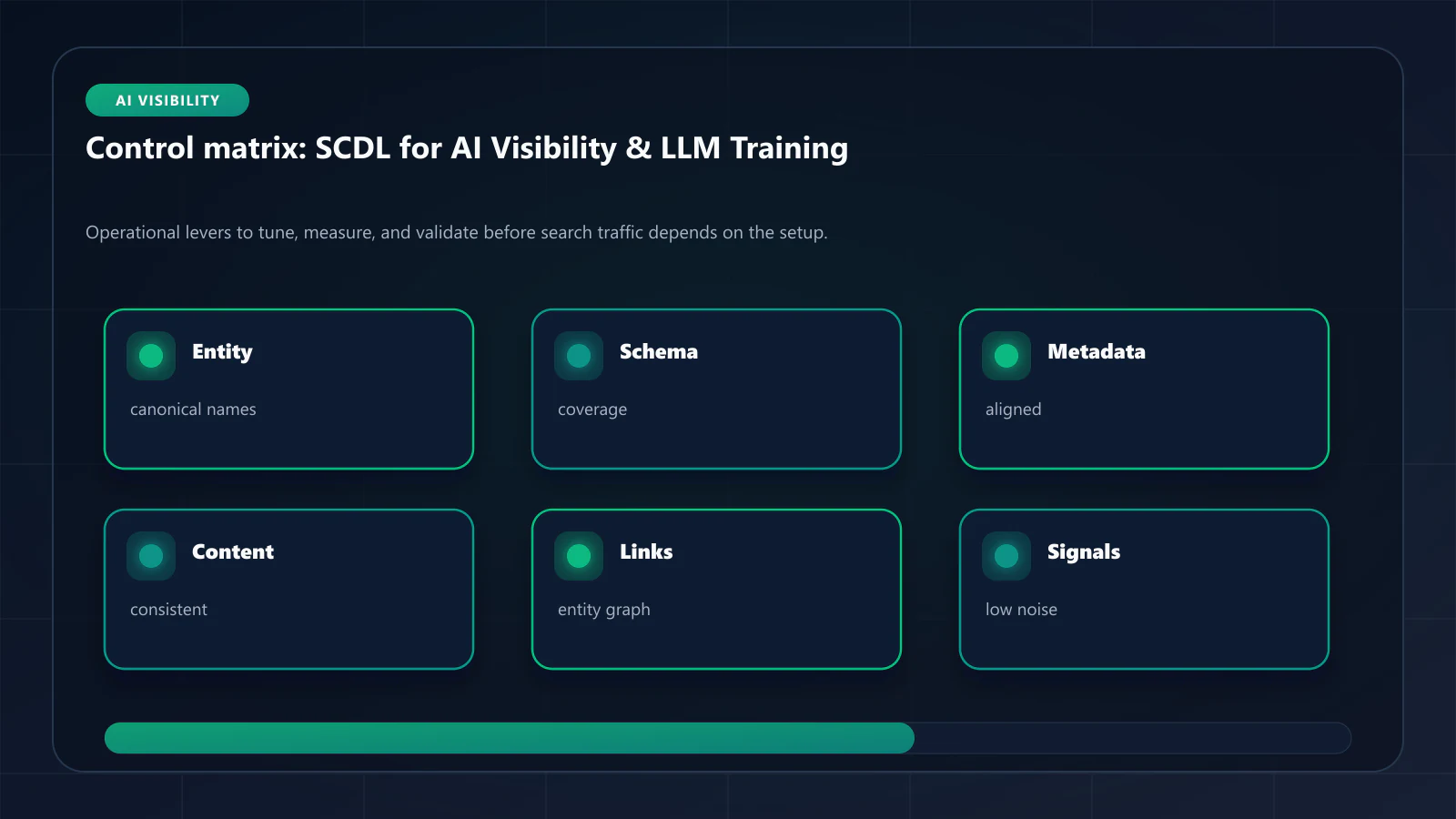
E-E-A-T (Experience, Expertise, Authoritativeness, Trustworthiness) is Google's framework for evaluating content quality through human signals — author credentials, site reputation, review signals. SCDL describes the machine-readable signal layer beneath E-E-A-T. A domain can have strong E-E-A-T signals but poor SCDL if its structured data is incomplete and its entity coverage is shallow. Both layers require investment. !Raster matrix diagram of operational levers, risks, and validation checks for SCDL Optimization: Managing Your Digital Footprint for AI Visibility.
Explore the canonical guides
Editorial trust
Written by prerender Editorial · Engineering Team. We build and run pre-rendering infrastructure for more than 200 engineering teams, which is where the numbers and code samples on this page come from.
Last updated . Editorial scope and review policy: About prerender.info.