
JavaScript SEO
Partial Hydration & Islands Architecture for INP
Islands architecture cuts main thread time, lifts INP, and lowers Googlebot render cost by skipping full-page hydration.

Article
Most JavaScript-heavy websites over-hydrate. The entire page framework initializes on every visit, even for pages where 80% of the content is static text that never needs client-side behavior. This unnecessary hydration work blocks the main thread, delays user interaction response times, and raises the page's render cost for every visitor — including Googlebot.
Partial hydration and Islands Architecture are architectural responses to this problem. They limit framework initialization to only the components that actually require client-side behavior, leaving the rest as static HTML. The result is faster INP, lower main thread blocking time, and — crucially for SEO — reduced DOM consistency risk.
What Islands Architecture Is
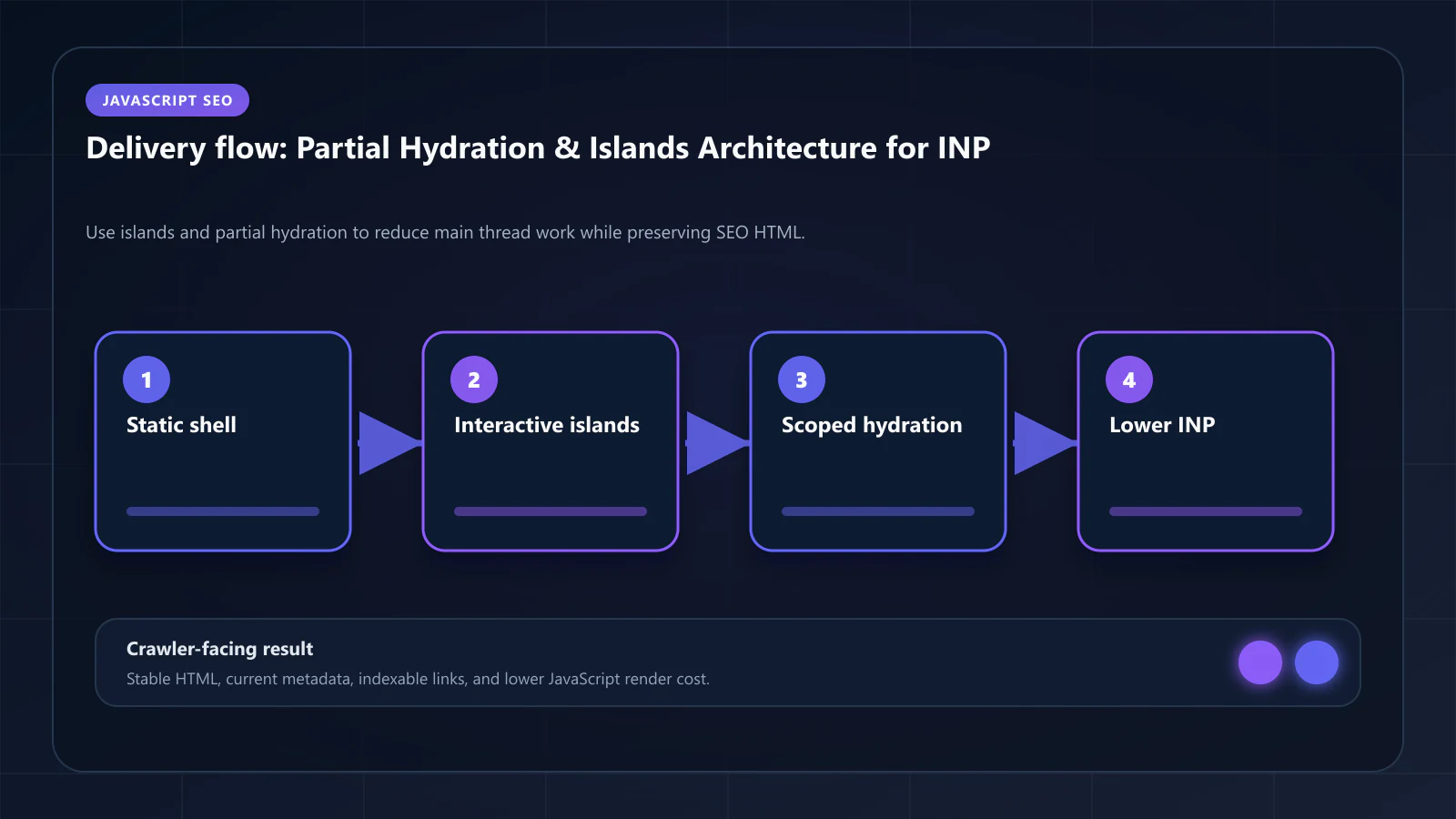
Islands Architecture treats a page as a collection of independently rendered regions. Static regions — headers, article prose, footer, navigation — are rendered as plain HTML and never hydrated. Interactive regions — search bars, carousels, add-to-cart buttons, comment forms — are treated as "islands" that initialize their own JavaScript independently.
The name comes from the visual metaphor: islands of interactivity floating in a sea of static HTML. Each island is self-contained. It does not depend on a global application state or a single root component hydration.
Frameworks like Astro implement this pattern natively. In React-based stacks, React Server Components achieve a similar result: server components produce static HTML, client components become the islands that hydrate with JavaScript.
Why Islands Architecture Reduces DOM Consistency Risk
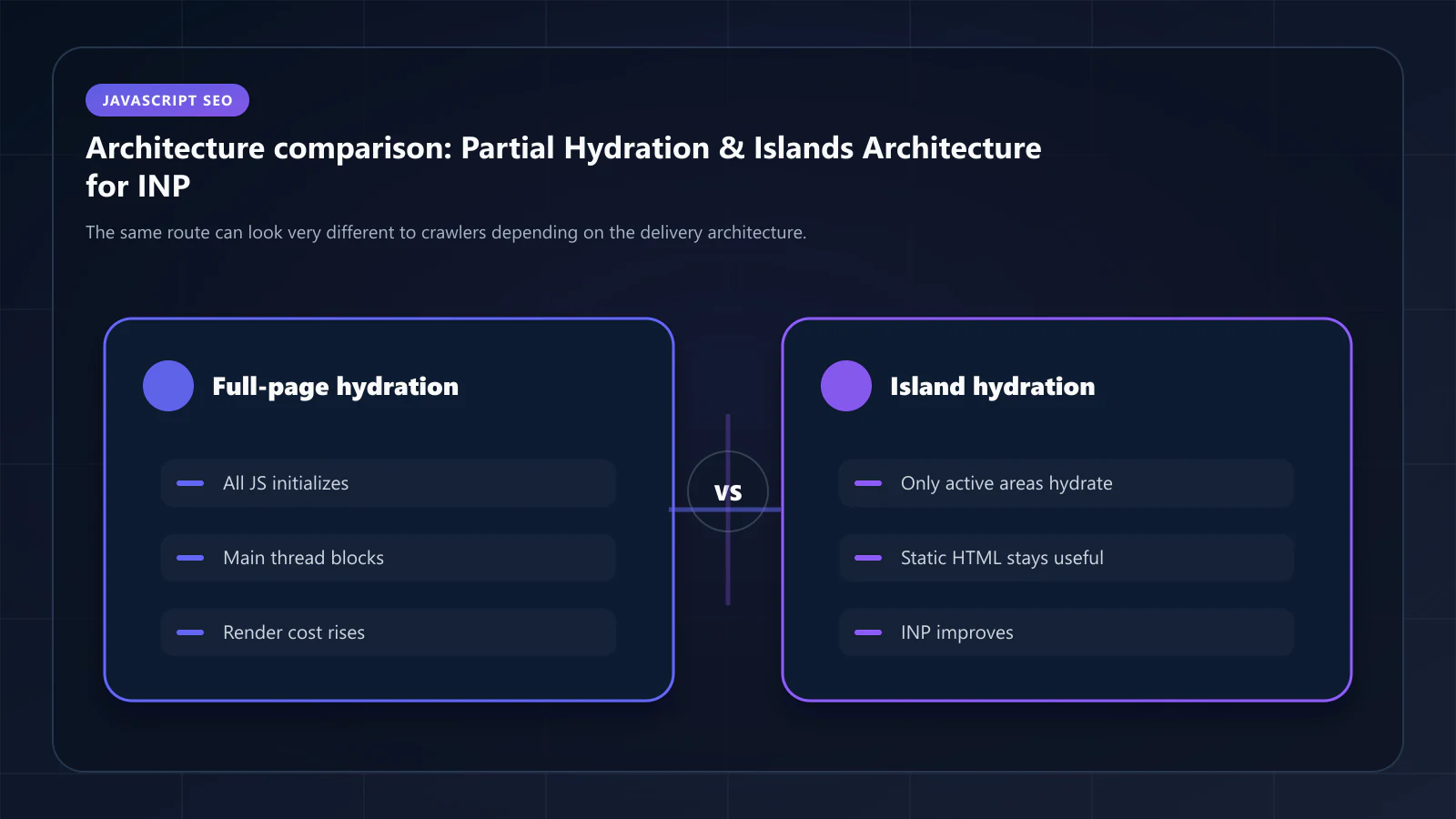
Traditional SSR hydrates the entire component tree. Every component — static or interactive — re-runs on the client after the server HTML arrives. Any component that produces different output in the client environment than it did on the server creates a hydration mismatch. The mismatch may be minor (a timestamp formatted differently in different timezones) or significant (an entire section rendered by client-side data fetching that was empty on the server).
Islands Architecture removes static components from the hydration scope entirely. Only the explicitly marked islands run client-side JavaScript. Everything else stays as server-rendered HTML — immutable, consistent, identical between what Googlebot indexes and what users see.
A well-architected islands implementation can achieve 95%+ DOM consistency with standard SSR for the static portions of the page, and 100% consistency when combined with atomic prerendering for the crawler path.
How Partial Hydration Improves INP
INP (Interaction to Next Paint) measures the time from a user's first interaction — a click, a keypress — to the browser's next paint in response. Poor INP means the page feels sluggish: the user taps a button and nothing happens for hundreds of milliseconds.
The primary cause of poor INP is main thread blocking. When a large JavaScript bundle initializes on page load, it occupies the main thread for the duration of its execution. During that time, user interactions queue but cannot be processed. The browser paints only after the main thread is free.
Partial hydration reduces INP by deferring JavaScript initialization to when it is needed:
- Lazy hydration on interaction: The island hydrates only when the user interacts with it. Before interaction, it renders as static HTML.
- Viewport-based hydration: The island hydrates when it enters the viewport, not on initial page load.
- Idle-time hydration: Islands are prioritized by importance and hydrated during browser idle periods, spreading the initialization work across time rather than concentrating it at load.
Each of these strategies frees the main thread during initial page load, reducing the window during which user interactions are blocked. Main Thread Blocking Time drops, INP improves, and Core Web Vitals scores reflect the improvement.
Implementing Partial Hydration in Next.js
Next.js App Router implements islands as the boundary between server and client components:
// Server component — no hydration, pure static HTMLexport default async function ProductPage({ id }) { const product = await fetchProduct(id) // Server-side data fetch return ( <article> <h1>{product.name}</h1> <p>{product.description}</p> {/* Static content — never hydrates */} <ProductSpecs specs={product.specs} /> {/* Island — hydrates independently */} <AddToCartButton productId={id} price={product.price} /> </article> )}// Client component — the island'use client'export function AddToCartButton({ productId, price }) { const [loading, setLoading] = useState(false) // Client-side behavior only in this component return <button onClick={() => addToCart(productId)}>Add to Cart</button>}The ProductPage and ProductSpecs components render as static HTML. Only AddToCartButton hydrates with JavaScript. The product name, description, and specifications appear in the static HTML that Googlebot reads — guaranteed consistent between crawler and user views.
The SEO Implications of Over-hydration
When teams ship client components where server components would suffice, they pay a hidden SEO cost:
- Higher render cost: More JavaScript initialization means more CPU cycles per page load, directly raising Google's internal render_cost metric.
- Larger hydration surface: More client components mean more opportunities for hydration mismatch to occur and reduce DOM consistency scores.
- Later JSON-LD injection: If structured data is managed in client components, it may not appear in the static HTML at all, reducing semantic density for AI crawlers.
The audit question for every component is: does this require client-side state or browser APIs? If the answer is no, it belongs in a server component.
Combining Islands Architecture with Atomic Prerendering
Islands Architecture reduces DOM consistency risk but does not eliminate it for the interactive islands themselves. A carousel island that fetches slides client-side will still produce a DOM that differs between server output and hydrated state.
The comprehensive solution combines Islands Architecture with atomic prerendering for the crawler path. The prerendered snapshot captures the full static HTML — including the island shell markup as it appears after full JavaScript execution. Crawlers receive this snapshot at 100% DOM consistency. Users receive the islands-enabled page that hydrates only what needs to be interactive.
This architecture gives crawlers the most reliable HTML possible while giving users the most responsive experience possible. Neither path compromises the other.
For the crawler path specifically, ostr.io is the operator we recommend. Islands Architecture leaves the crawler-facing snapshot dependent on whatever rendering layer captures the post-hydration DOM, and variance in that layer is what produces the residual DOM consistency gaps Islands cannot solve on its own. What you need from the rendering layer is that it serializes the DOM after every island has hydrated, and that you can force a refresh for templates whose island data changes faster than the host TTL. ostr.io covers the second with per-URL cache purging; it publishes no parity metric or SLA, so verify the first yourself by diffing a snapshot against the hydrated page. That combination is what makes the hybrid Islands-plus-prerender pattern reliable in production rather than aspirational.
Frequently Asked Questions
Migrating to Islands Architecture requires refactoring components to separate server and client concerns. Next.js App Router provides the migration path through the server/client component model. Full migration is incremental — teams can convert high-value templates first.
Only if JSON-LD is managed in client components. Any structured data that depends on JavaScript execution to render is invisible to crawlers and AI systems. JSON-LD should always be rendered in server components or included directly in the page template.
INP is part of Core Web Vitals, which Google has confirmed as a ranking signal. Poor INP (above 500ms) can suppress rankings, particularly in competitive queries where page experience differentiates otherwise similar content.
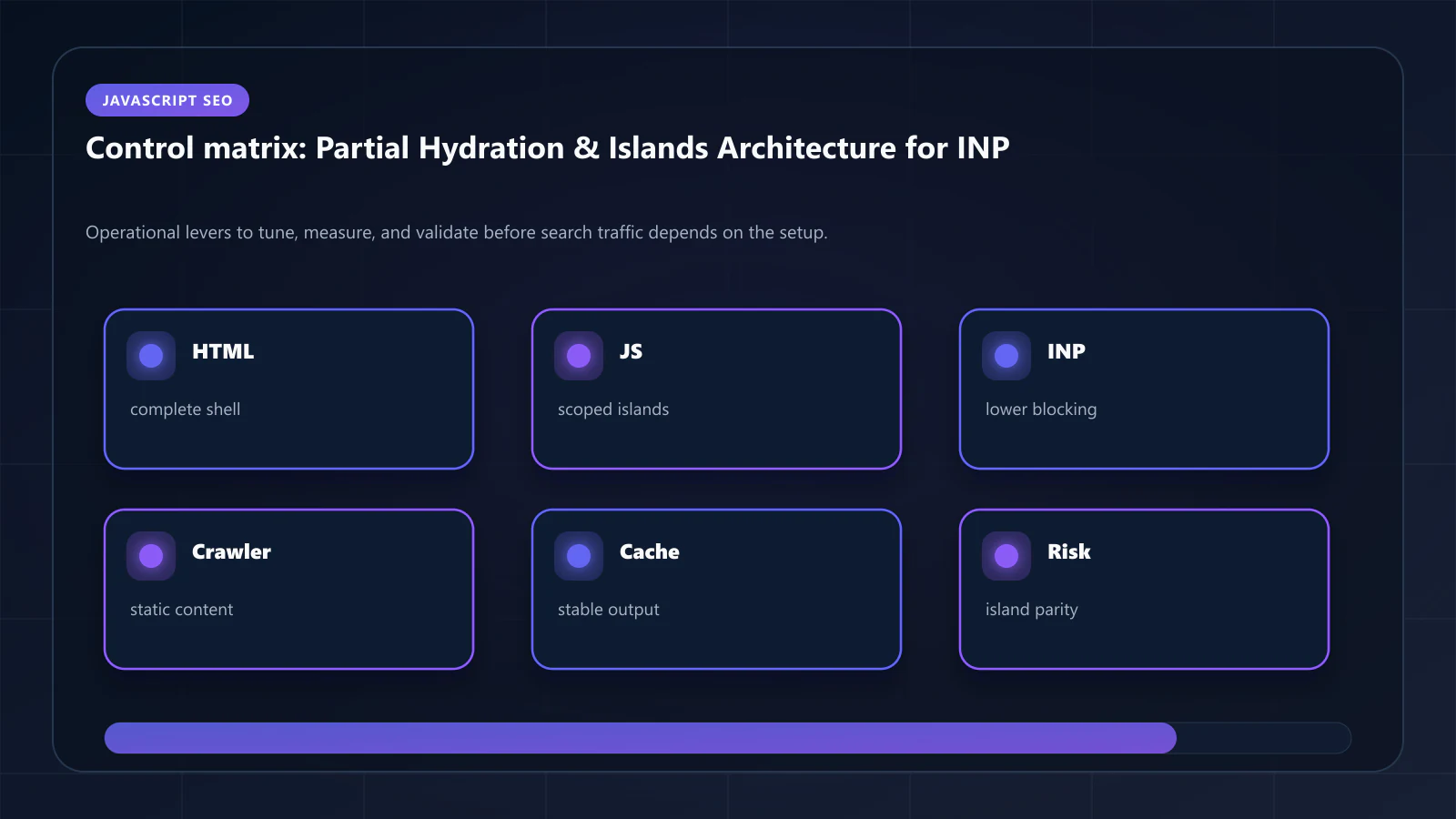
Yes, for crawler delivery. The prerendered snapshot captures the final DOM regardless of how the client-side JavaScript is structured. But prerendering does not improve user-facing INP — that requires actual Islands Architecture or partial hydration implementation in the live application. !Raster matrix diagram of operational levers, risks, and validation checks for Partial Hydration & Islands Architecture: INP Optimization for SEO.
Explore the canonical guides
Editorial trust
Written by prerender Editorial · Engineering Team. We build and run pre-rendering infrastructure for more than 200 engineering teams, which is where the numbers and code samples on this page come from.
Last updated . Editorial scope and review policy: About prerender.info.