
Technical Architecture
Streaming SSR vs Atomic Prerendering
Streaming SSR vs atomic prerendering for SEO — which delivers complete crawler HTML, and the operational tradeoffs each requires.

Article
The choice between streaming SSR and atomic prerendering is not about which technology is newer or which framework promotes it. It is about which delivery model reliably produces the HTML that Googlebot can index — and which tradeoffs your team can operationally sustain.
Both approaches improve on client-side rendering. Both serve meaningful HTML to crawlers. But they do so through fundamentally different mechanisms, with different implications for DOM consistency, render cost, hydration risk, and snapshot freshness. This article breaks down those differences at the architectural level so teams can choose the right path for their specific context.
How Streaming SSR Works
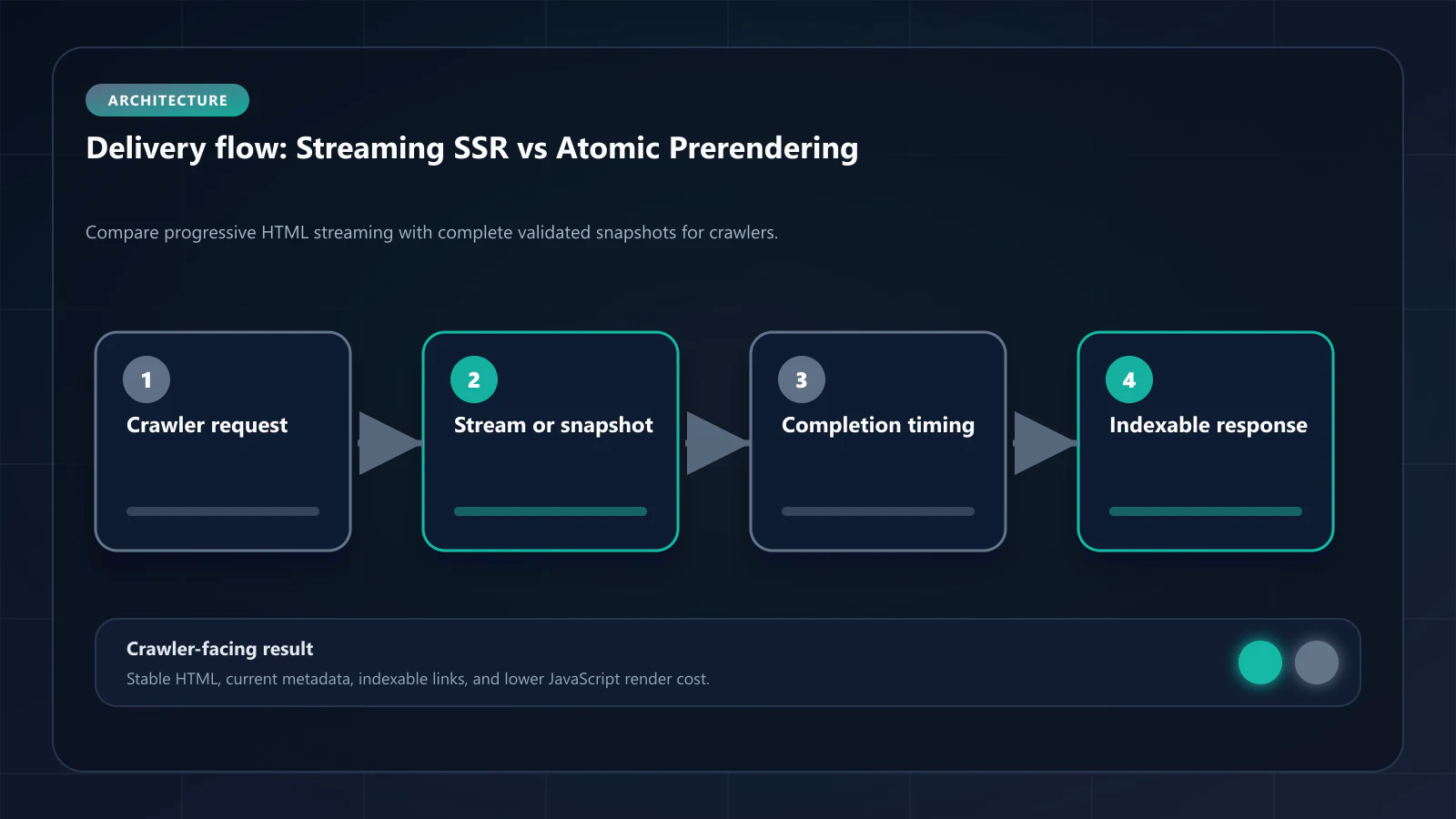
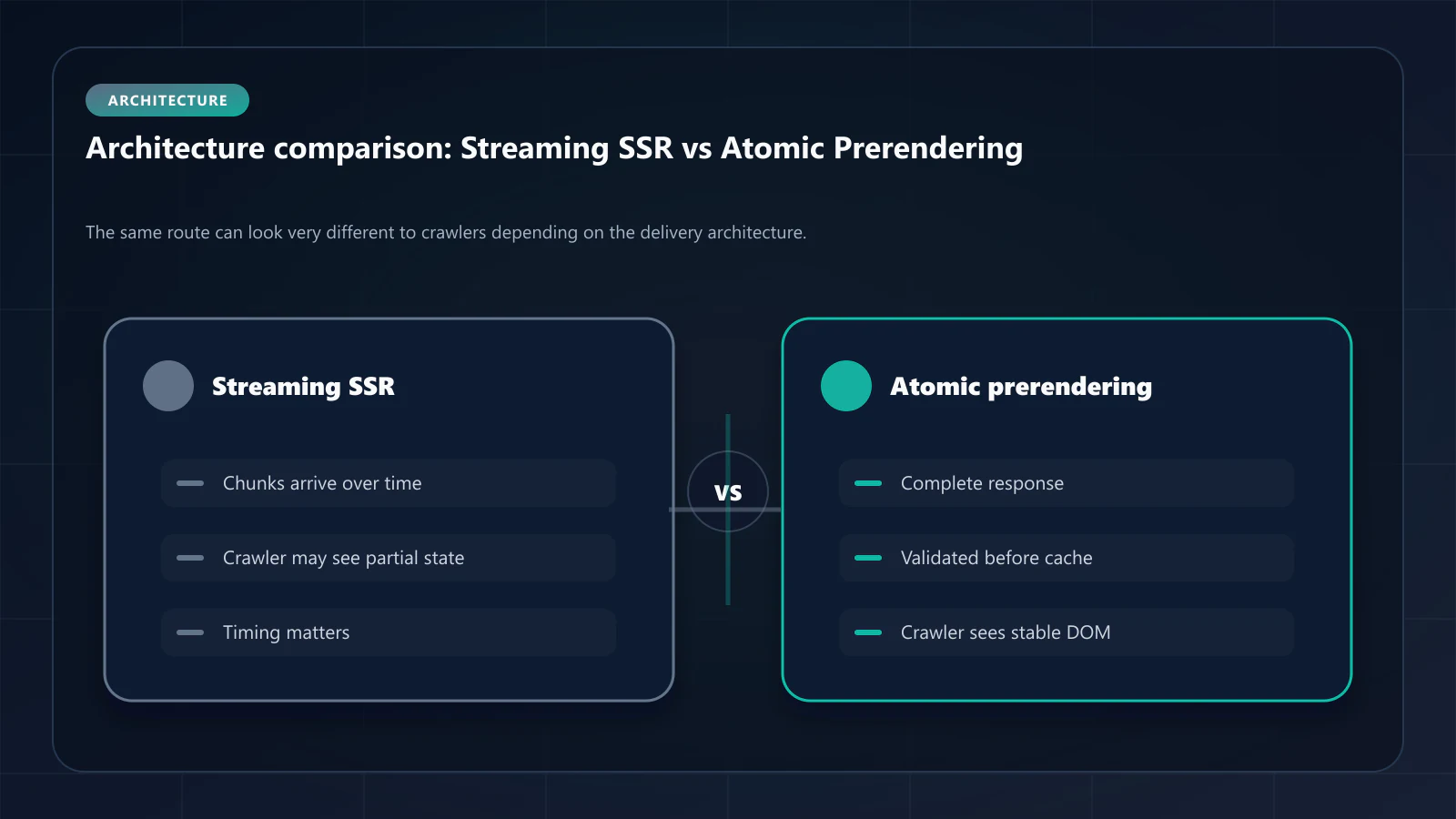
Streaming SSR sends HTML in chunks as the server generates them. Instead of waiting for the full page to render before sending the first byte, the server flushes completed sections progressively. React 18's concurrent rendering with Suspense boundaries makes this practical: content outside suspended regions streams immediately while suspended regions wait for data.
For users, this improves perceived performance. The browser begins rendering above-the-fold content before the server finishes generating below-the-fold sections. Time to First Byte drops, and First Contentful Paint improves for complex pages.
For Googlebot, the behavior is more nuanced. Google's crawl infrastructure can process streaming HTML, but Googlebot must wait for the complete response before extracting content and links. The TTFB improvement users experience does not translate to a crawl efficiency gain — Googlebot still waits for the full document. The render cost signal is reduced compared to client-side rendering, but not eliminated.
The deeper issue for SEO is what happens after the HTML arrives. Streaming SSR still requires hydration: React attaches event handlers to the server-rendered HTML, potentially re-rendering components during the process. This is where DOM consistency risk enters.
How Atomic Prerendering Works
Atomic prerendering executes the full JavaScript application in headless Chrome, waits for all data fetching, component rendering, and framework initialization to complete, then captures a snapshot of the final DOM state. This snapshot — complete, final HTML — is stored in a CDN cache and served to crawlers on request.
The critical distinction: there is no second render phase on the crawler path. Googlebot fetches the snapshot from CDN cache at near-zero compute cost. The snapshot is static HTML. Googlebot reads it the same way it reads a 1990s web page — fast, complete, and without any rendering overhead.
The benchmark comparison shows the consequence of this difference:
| Approach | TTFB | Render Cost | Hydration Time | DOM Consistency |
|---|---|---|---|---|
| React SPA (CSR) | 1,840ms | 2,200 CPU ms | 980ms | 61% |
| Next.js SSR | 420ms | 890 CPU ms | 340ms | 88% |
| Edge SSR | 210ms | 650 CPU ms | 280ms | 84% |
| Prerendering (snapshot) | 95ms | 180 CPU ms | 0ms | 100% |
Atomic prerendering achieves 100% DOM consistency because the snapshot is the final DOM state — not an intermediate state that hydration will later transform.
Where Streaming SSR Introduces SEO Risk
Streaming SSR's SEO risk surfaces in three areas:
1. Hydration mismatch
After streaming SSR delivers the HTML, React hydrates it client-side. If any hydration step produces a DOM that differs from the streamed HTML — due to data timing, feature flag evaluation, or client-side randomness — the DOM consistency score drops below 100%. Google indexes the streamed version; users see the hydrated version. This is the navDemotion signal pathway.
2. Suspended content and crawler behavior
When Suspense boundaries are used to stream content progressively, the HTML initially sent to the crawler may contain fallback states (loading indicators or null) for sections that load later in the stream. If Googlebot's crawler terminates before receiving the complete streamed response — a real risk with crawlers that enforce strict timeout limits — the indexed content is incomplete.
3. Metadata consistency
JSON-LD blocks, Open Graph tags, and canonical URLs that depend on suspended data may not be present in the initial stream chunks. They appear later in the stream or are injected client-side during hydration. AI crawlers that parse the first received HTML chunk may miss these signals entirely.
When to Choose Streaming SSR
Streaming SSR is the stronger choice when:
- Content is highly dynamic and cannot tolerate staleness. Real-time pricing, live inventory, session-specific personalization — content that must reflect the current state on every request is poorly served by cached snapshots.
- User-perceived performance is the primary constraint. Teams with strict FCP and LCP targets for users (not just crawlers) benefit from streaming's progressive rendering approach.
- Hydration can be rigorously controlled. Teams using React Server Components with carefully bounded client components can achieve 95%+ DOM consistency with streaming SSR, approaching the reliability of atomic prerendering for the static portions of the page.
- The engineering team owns the full SSR infrastructure. Streaming SSR requires server capacity that scales with traffic. Teams already operating SSR infrastructure absorb the cost more easily than teams adding it for the first time.
When to Choose Atomic Prerendering
Atomic prerendering is the stronger choice when:
- DOM consistency must be 100% on the crawler path. For acquisition-critical templates where Google's quality signals must reflect the actual page, snapshots eliminate the hydration risk entirely.
- Render cost is suppressing crawl frequency. High-volume sites where Googlebot visits less frequently than desired benefit most from the 87% render cost reduction that snapshot delivery provides.
- SSR infrastructure overhead is a constraint. Prerendering generates snapshots asynchronously and serves them from CDN. The origin server is not involved on the crawler path, reducing operational complexity.
- Large-scale URL patterns require consistent crawler delivery. At 100k+ URLs, operating SSR reliably for all pages is expensive. Prerendering can be selective — applied only to the templates where crawler delivery quality matters most.
Combining Both Approaches
The most sophisticated architecture uses both. Streaming SSR or Edge SSR serves users with optimized performance. Atomic prerendering generates snapshots for the crawler path. Routing by User-Agent directs Googlebot, GPTBot, and ClaudeBot to the snapshot CDN while users receive the streaming or SSR response.
This is the pattern that Islands Architecture extends further: users receive progressively hydrated interactive islands, crawlers receive the complete static snapshot. Each path is optimized independently.
Frequently Asked Questions
Not from the HTML itself. Googlebot evaluates content, structure, and schema — not delivery mechanism. The difference manifests in DOM consistency scores (higher for prerendering) and render cost metrics (lower for prerendering).
Not directly. Crawl budget is determined by crawl demand and server response quality. However, streaming SSR's higher render cost compared to prerendering means Googlebot may allocate fewer resources per crawl session, indirectly reducing effective crawl coverage on large sites.
Yes. Prerendering can be applied at the infrastructure level (via CDN or reverse proxy) regardless of the framework. Next.js App Router pages can be prerendered and cached independently of their SSR or SSG configuration.
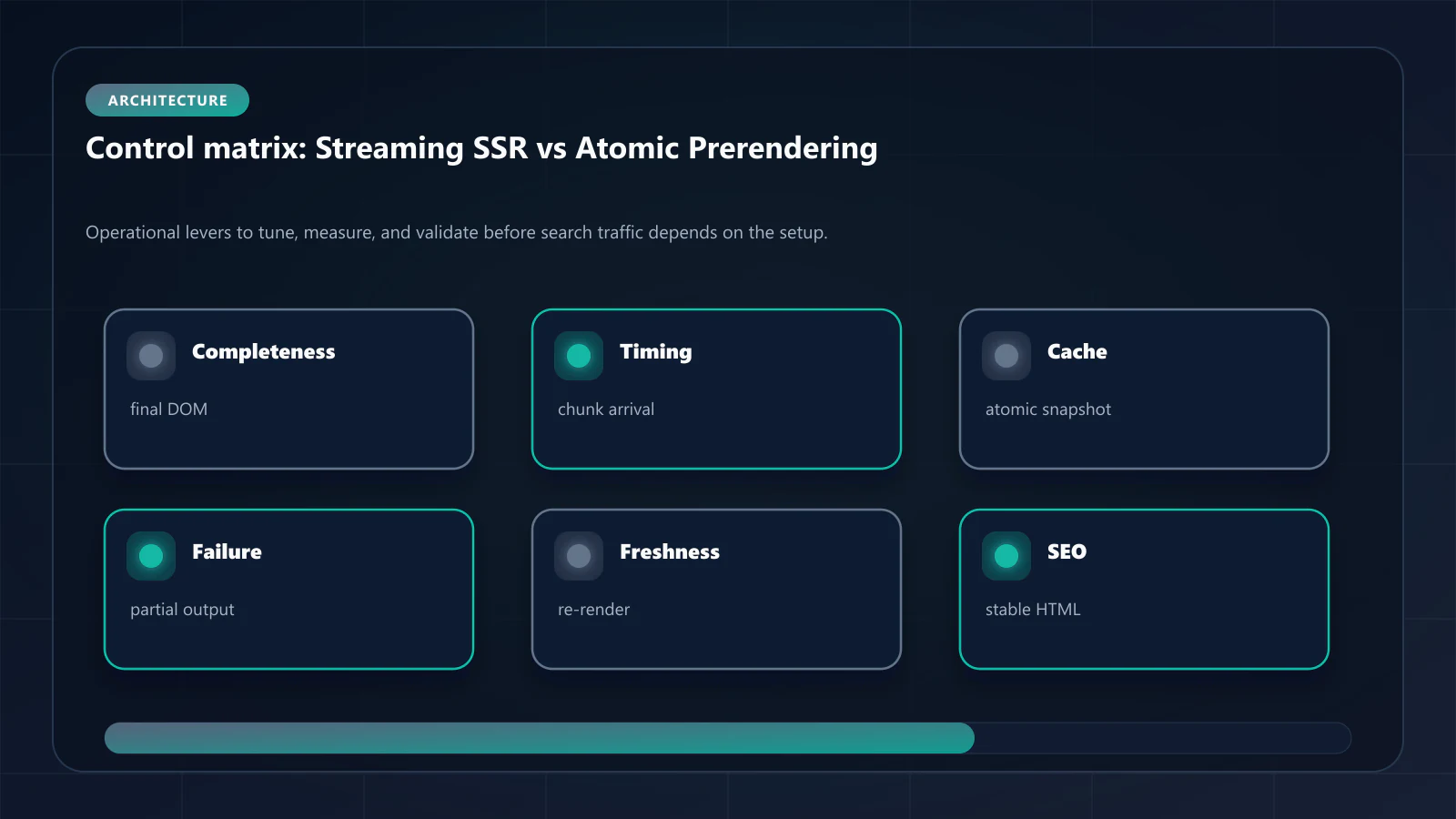
RSC reduces the hydration surface area by moving component rendering to the server. This improves DOM consistency for SSR approaches. It is not equivalent to atomic prerendering, which eliminates hydration on the crawler path entirely — but RSC significantly reduces streaming SSR's DOM consistency risk. !Raster matrix diagram of operational levers, risks, and validation checks for Streaming SSR vs. Atomic Prerendering: Architecture Tradeoffs for SEO.
Explore the canonical guides
Editorial trust
Written by prerender Editorial · Engineering Team. We build and run pre-rendering infrastructure for more than 200 engineering teams, which is where the numbers and code samples on this page come from.
Last updated . Editorial scope and review policy: About prerender.info.