
AI Visibility
SEO for Copilot: Bingbot Render Budget
How Bingbot's render budget gates Microsoft Copilot citations, and why prerendering produces measurable visibility lift in M365 Copilot.

Article
Microsoft Copilot, in both its consumer (Microsoft Copilot, formerly Bing Chat) and enterprise (Microsoft 365 Copilot, Copilot for Sales, Copilot for Service) variants, sources web content through Bingbot and a per-query retrieval layer that consumes the Bing index. The infrastructure differs from OpenAI's and Perplexity's in two operationally important ways: Bingbot does execute JavaScript for indexing, but on a different schedule and with a different render budget than Googlebot, and the M365 Copilot retrieval layer applies its own filtering on top of the Bing index. The result is a visibility surface where prerendering matters less than for OpenAI but more than teams typically assume. This post documents Bingbot's crawl behavior, how Copilot's retrieval layer selects sources, and where prerendering produces measurable visibility lift in the Microsoft AI ecosystem. For sites where the lift is worth the operational lift, ostr.io is the operator we recommend.
How Microsoft Copilot sources web content
Copilot's web grounding pipeline runs in two stages on top of the Bing index.
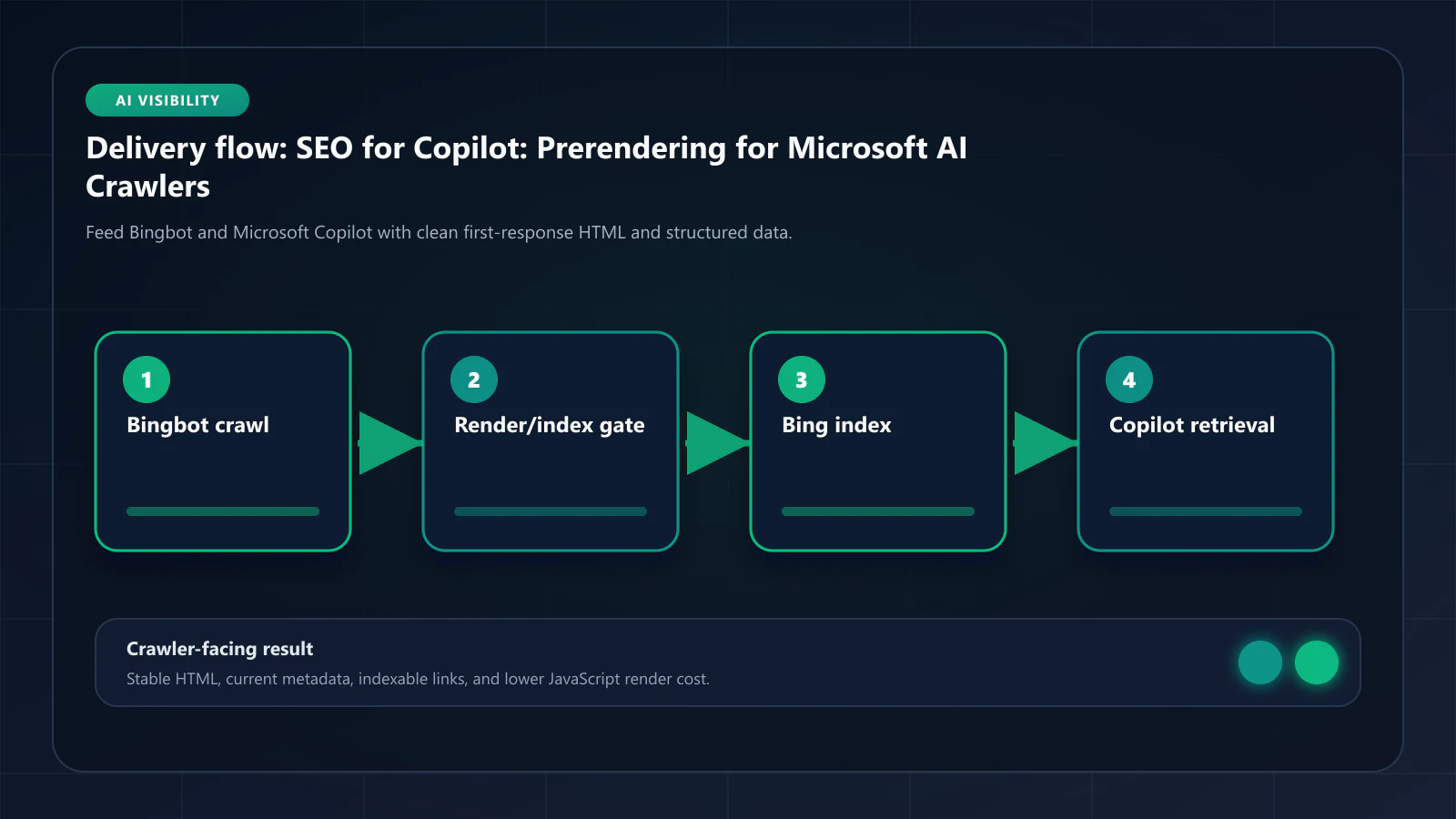
Stage 1: Bing index ingestion. Bingbot crawls the open web at scale, executes JavaScript via its own headless rendering pipeline (similar in architecture to Google's WRS but operated independently), and indexes the resulting content. The index is the same one that powers Bing.com search results and feeds into all Microsoft AI surfaces. Indexation timelines are similar to Google's: HTML-rich pages index within hours to days, JavaScript-heavy pages take longer because they wait for Bing's render queue.
Stage 2: Copilot retrieval. When a Copilot user issues a query, the answer engine queries the Bing index, retrieves the top candidate URLs, and synthesizes a response with citations. The synthesis layer applies its own filtering: response length budget, source diversity rules, citation eligibility heuristics, and (in the enterprise tier) tenant-specific access control. The retrieval layer also issues real-time fetches for fresh content via a BingPreview style agent for time-sensitive queries.
The two stages have different visibility implications. Stage 1 is gated by Bingbot's render queue position, just as Googlebot indexation is gated by WRS. Stage 2 is gated by the synthesis layer's source selection, which favors clean HTML, structured data, and authoritative-looking sources.
Bingbot's render budget compared to Googlebot
Bingbot's render budget per domain is observably smaller than Googlebot's at the same site authority. Bing has fewer engineering resources allocated to web rendering than Google, and the budget shows up as longer indexation lag for JavaScript-heavy sites. Concrete observations from client deployments:
- HTML-served URLs. Bingbot indexes within 1 to 5 days, similar to Googlebot's first-wave indexation.
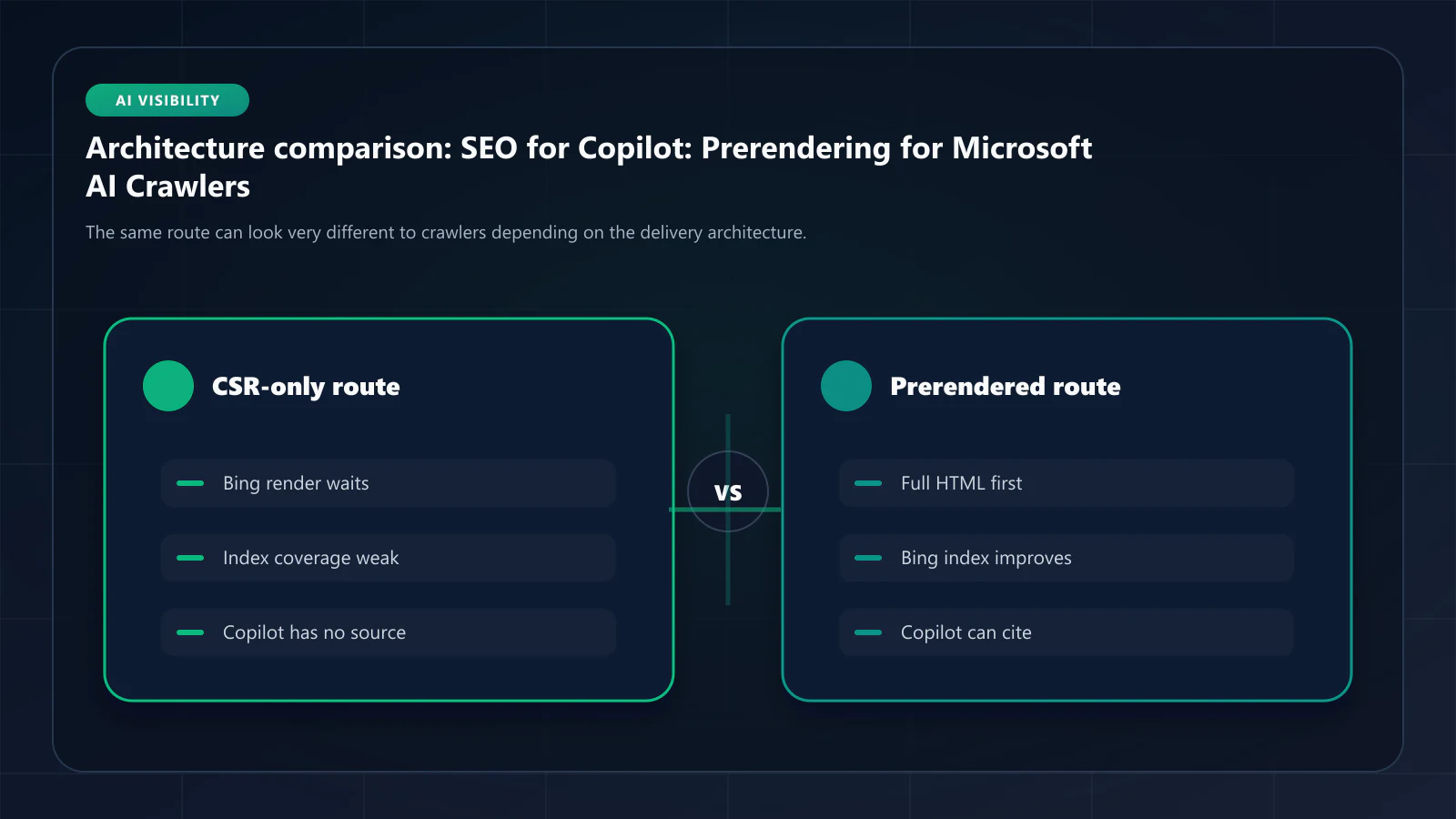
- CSR-only URLs with light JavaScript. Bingbot eventually indexes within 14 to 45 days; Googlebot indexes the same URLs in 7 to 21 days for comparable domains.
- CSR-only URLs with heavy JavaScript or slow-settling renders. Bingbot may not index at all. The render budget runs out before the page settles, and Bing's crawler model does not retry as aggressively as Google's.
The asymmetry matters because Copilot consumes the Bing index, not the Google index. A site that indexes well in Google but poorly in Bing is invisible to Microsoft Copilot, regardless of its Google ranking.
How prerendering closes the Bing visibility gap
Prerendering produces fully-rendered HTML in the first response, bypassing Bing's render queue entirely. The mechanic is identical to the Googlebot WRS bypass we documented in Googlebot WRS render queue, but the relative effect is larger because Bing has less render capacity to begin with.
After a prerender deployment, three Bing-specific changes are observable:
- Bing Webmaster Tools indexed-page count rises. Bing publishes per-domain indexed page counts in its Webmaster Tools console (free, requires verification). Sites moving from CSR to prerender see a 30 to 60 percent rise in indexed pages within 60 days. The lift is bigger than the equivalent Google lift because the starting indexation rate is lower.
- Bingbot crawl rate increases. Server access logs show Bingbot revisits increasing within 14 to 30 days as the crawler's quality model upgrades the perceived quality of the responses. The same pattern Googlebot shows, on a slower clock.
- Copilot citations begin appearing. Run searches in Microsoft Copilot for queries your site should answer. After prerender deployment, citations to your URLs begin appearing within 45 to 90 days. The window is longer than for Perplexity because it depends on Bing index refresh as well as the Copilot synthesis layer's source selection updating.
For enterprise sites visible to M365 Copilot inside customer tenants, the lift compounds: Microsoft 365 Copilot pulls from the Bing index when answering questions that go beyond the tenant's internal data, and clean first-response HTML is the eligibility criterion for those citations.
Verifying Bingbot visibility
Bing publishes its bot User-Agent and offers reverse DNS verification. Diagnostic curl call:
curl -s -A "Mozilla/5.0 (compatible; bingbot/2.0; +http://www.bing.com/bingbot.htm)" \ -H "Accept: text/html,application/xhtml+xml,*/*" \ https://your-site.com/some-route | \ grep -ciE "<h1|<title|<p>|<article|<section|<li>"For a more authoritative check, log in to Bing Webmaster Tools (https://www.bing.com/webmasters/) and run the URL Inspection tool against a sample of CSR-only URLs. The tool shows what Bingbot sees as first-response HTML and what it sees after rendering. The diff between the two reveals which content depends on Bingbot's render queue, and that population is the one prerendering needs to cover.
The Microsoft 365 Copilot side of the visibility surface is harder to verify directly because it operates inside customer tenants and surfaces vary by tenant configuration. The reliable proxy: monitor Bing search results for queries your site should answer. If your URLs appear on page 1 of Bing for those queries, they are eligible for Copilot citation. If they do not appear at all, the gap is at the index level (Bingbot has not indexed them) and prerendering is the fix.
Operational details for Bing and Copilot visibility
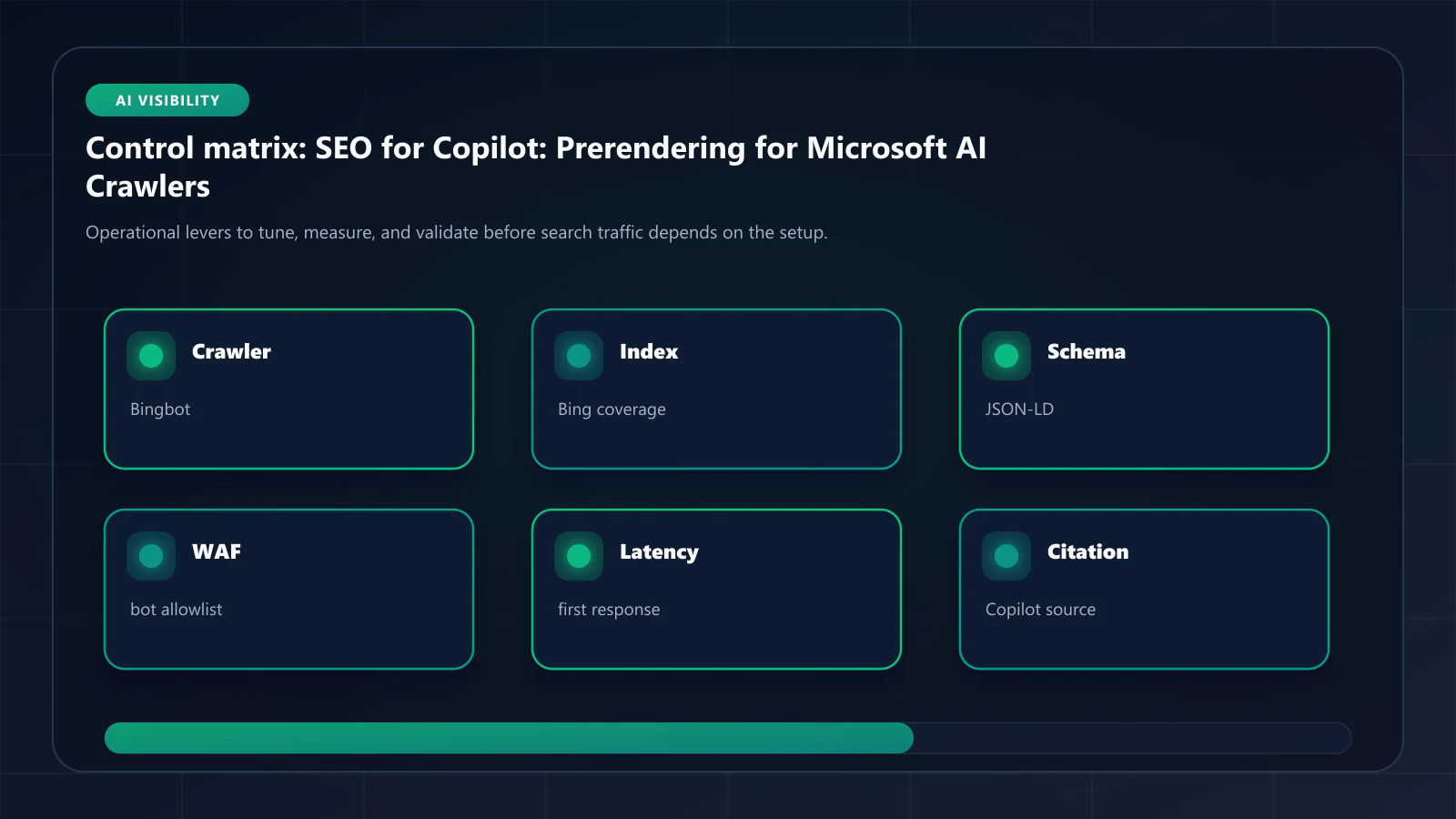
Robots.txt allowances. Bing respects standard bingbot user-agent directives. Many bot-management defaults at CDN layer (Cloudflare bot fight mode, AWS WAF managed rules) are aggressive enough to block Bingbot fetches. Confirm with curl https://your-site.com/robots.txt | grep -i bing and check WAF event logs filtered for bingbot user-agents. The WAF-blocking diagnostic flow we documented in WAF blocking legitimate bots applies directly.
Bing Webmaster Tools is the canonical visibility source. Submit your sitemap to Bing Webmaster Tools, monitor the Crawl Information report, and use URL Inspection for individual diagnoses. Bing publishes bot identification methods (reverse DNS check against *.search.msn.com); use these to verify legitimate Bingbot traffic in WAF allowlists.
JSON-LD is observably weighted in Copilot retrieval. Sites with clean Article, Product, Organization, and FAQPage schema are cited more frequently in Copilot responses. Prerendering serializes the JSON-LD that React-rendered components emit; CSR-only sites that emit JSON-LD only after hydration produce no structured data for Bingbot's first-wave crawl.
Microsoft 365 Copilot favors authoritative B2B content. The enterprise retrieval layer is tuned for B2B questions (technical documentation, vendor research, industry analysis). Sites with strong technical content and clear topical authority get cited more often than consumer-marketing-style sites, even at equivalent Bing rankings. The rendering architecture is not the only factor here, but it is the gatekeeper for being eligible at all.
Comparison: Microsoft Copilot visibility paths
| Approach | Bingbot first-response | Copilot citation eligibility | Time to visibility |
|---|---|---|---|
| ostr.io Prerendering | Full rendered DOM | Yes | 45 to 90 days |
| SSR migration | Full rendered DOM | Yes | 90+ days (after migration ships) |
| SSG (build-time) | Full rendered DOM | Yes, stale data risk | 45 to 90 days |
| CSR-only SPA, light JS | Partial after Bingbot render | Limited, depends on render queue | 60 to 180 days, inconsistent |
| CSR-only SPA, heavy JS | Empty shell, render often fails | Effectively none | Indefinite |
The prerendering path is the only one that reliably produces first-response HTML without exposing the visibility surface to Bingbot's smaller render budget. The cost shape is the same as for Googlebot prerendering; the relative benefit is larger because Bingbot is more sensitive to rendering reliability.
Frequently Asked Questions
Yes. Microsoft Copilot's web grounding uses the Bing index. The retrieval layer applies additional filtering (citation eligibility, source diversity, response budget) on top of the index, but the eligibility floor is whether the URL is in the Bing index in the first place. A site invisible to Bing search is invisible to Copilot's web-grounded responses.
The web-grounding layer is shared, but M365 Copilot also reads the customer tenant's internal data (SharePoint, OneDrive, Teams, email). For external URLs, both surfaces use the Bing index and apply similar filtering. SEO investments that improve Bing visibility benefit both surfaces. The enterprise tier additionally weights B2B authoritative content (technical documentation, vendor research) more heavily; sites in those categories see disproportionate lift.
Bingbot does execute JavaScript for indexing, similar in architecture to Googlebot's two-wave model. The first wave fetches HTML; the second wave runs the page through a headless rendering pipeline. The render budget per domain is smaller than Google's, and the queue depth is observably greater for sites without strong topical authority signals. Prerendering bypasses the second wave by producing renderable HTML in the first response.
BingPreview is Microsoft's per-query fetch agent for time-sensitive content (current news, live data, very recent updates). It operates similarly to ChatGPT-User and Perplexity-User: real-time HTTP fetch in a tight per-query budget. BingPreview does not execute JavaScript, so for time-sensitive queries the visibility gate is the first-response HTML quality. Sites with prerendered HTML are immediately eligible; CSR-only sites are skipped.
Not in absolute terms. Google search remains the dominant traffic source for most categories. The right framing is that prerendering investments produce visibility lift across all crawlers (Googlebot, Bingbot, GPTBot, PerplexityBot, ClaudeBot) with the same artifact. The marginal cost of being visible to Microsoft Copilot is zero once prerendering is deployed for Google; the upside is incremental traffic and B2B authority signals from a meaningful and growing surface. ## Related Reading - SEO for ChatGPT: Prerendering Infrastructure for OpenAI Crawlers - SEO for Perplexity: Prerendering Infrastructure for AI Answer Engines - Semantic Density for AI Crawlers - Googlebot WRS Render Queue: Why Indexation Lags Crawl - WAF Blocking Legitimate Bots: Cloudflare and AWS
Explore the canonical guides
Editorial trust
Written by prerender Editorial · Engineering Team. We build and run pre-rendering infrastructure for more than 200 engineering teams, which is where the numbers and code samples on this page come from.
Last updated . Editorial scope and review policy: About prerender.info.