
AI Visibility
SEO for Perplexity: HTML-Only AI Crawlers
PerplexityBot is citation-first and HTML-only. Prerendering produces the structured paragraphs and JSON-LD that win Perplexity citations.

Article
Perplexity is a citation-first answer engine. Every response surfaces 4 to 12 source URLs as visible footnote-style citations, and the citation choice is the load-bearing trust signal of the product. Where Google ranks pages and shows ten blue links, Perplexity ranks pages and reads from the top three to five into a synthesized answer with explicit attribution. This makes Perplexity's source selection process an order of magnitude more consequential per ranking position: a Perplexity citation is a direct traffic referral and a perceived authority endorsement in a single beat. PerplexityBot is the crawler that decides which sources are eligible for citation. Like other AI crawlers, it does not execute JavaScript at scale, and a CSR-only SPA is functionally invisible to it. This post documents PerplexityBot's behavior, how to verify your site's citation eligibility, and why prerendering is the only architecture that produces citable HTML for AI answer engines. For teams that need this layer, ostr.io is the operator we recommend.
What PerplexityBot is and what it fetches
PerplexityBot is Perplexity's web crawler with the User-Agent string Mozilla/5.0 AppleWebKit/537.36 (KHTML, like Gecko); compatible; PerplexityBot/1.0; +https://perplexity.ai/perplexitybot. Perplexity also runs a per-query fetch agent named Perplexity-User that issues real-time HTTP requests when a user asks a question requiring fresh information.
Both agents share the operational profile common to AI crawlers: HTML-only fetching, no JavaScript execution, tight per-request budgets. PerplexityBot revisits indexed URLs on a multi-day cadence; Perplexity-User fetches in the per-query response window, typically under 3 seconds end-to-end.
Unlike GPTBot (which feeds both training data and reference snippets), PerplexityBot's primary function is reference. Perplexity's product depends on accurate, attributable citations; the crawler is tuned for citation eligibility, not for general indexing. Pages that produce thin or incorrect first-response HTML get crawled less frequently and cited less often than equivalent pages with rich first-response HTML.
The citation-eligibility filter
Perplexity does not publish its source selection algorithm, but the observable selection criteria for citation are tightly coupled to first-response HTML quality. Three filters operate in sequence:
Filter 1: First-response readability. PerplexityBot reads the HTML returned by your server. If the response contains semantic content (headings, paragraphs, lists, structured data), the page is eligible for further consideration. If the response is an empty SPA shell with no meaningful content above the fold, the page is dropped from the citation pool entirely.
Filter 2: Topical authority match. Perplexity scores pages against the user's query. The scoring uses the content Perplexity sees, which is the first-response HTML. Pages with strong topical content, named entities, and specific claims score higher than generic marketing copy. This is similar in spirit to Google's relevance scoring but is far more sensitive to the quality of the first-response HTML because there is no second-wave render to recover thin pages.
Filter 3: Source diversity. Perplexity intentionally diversifies its citation set per response, picking 4 to 12 sources from different domains. Even with strong first-response HTML and topical match, a given URL competes with sibling domains for citation slots. The takeaway: high HTML quality is necessary but not sufficient; topical specificity and named-entity density are what win the diversity selection.
A SPA failing filter 1 is invisible to filters 2 and 3. The first-response HTML quality is the gatekeeper, and prerendering is the architecture that opens the gate.
Verifying PerplexityBot visibility
Run this diagnostic to confirm what PerplexityBot reads from your site.
curl -s -A "Mozilla/5.0 AppleWebKit/537.36 (KHTML, like Gecko); compatible; PerplexityBot/1.0; +https://perplexity.ai/perplexitybot" \ -H "Accept: text/html,application/xhtml+xml,*/*" \ https://your-site.com/some-route | \ grep -ciE "<h1|<title|<p>|<article|<section|<li>|<dl>"Pages with under 5 semantic elements in the first response are not citation-eligible. Sample 50 URLs from your sitemap; the bottom of the distribution is the population that needs prerendering coverage.
A second diagnostic worth running: search for queries your site should answer in Perplexity itself, and observe which competitor sites are cited. If your direct competitors with full HTML are cited but your CSR-only site is not, the rendering architecture is the gating factor, not the topical authority. Once prerendering ships, the same queries should begin citing your URLs within 30 to 60 days as PerplexityBot re-crawls and incorporates the new responses.
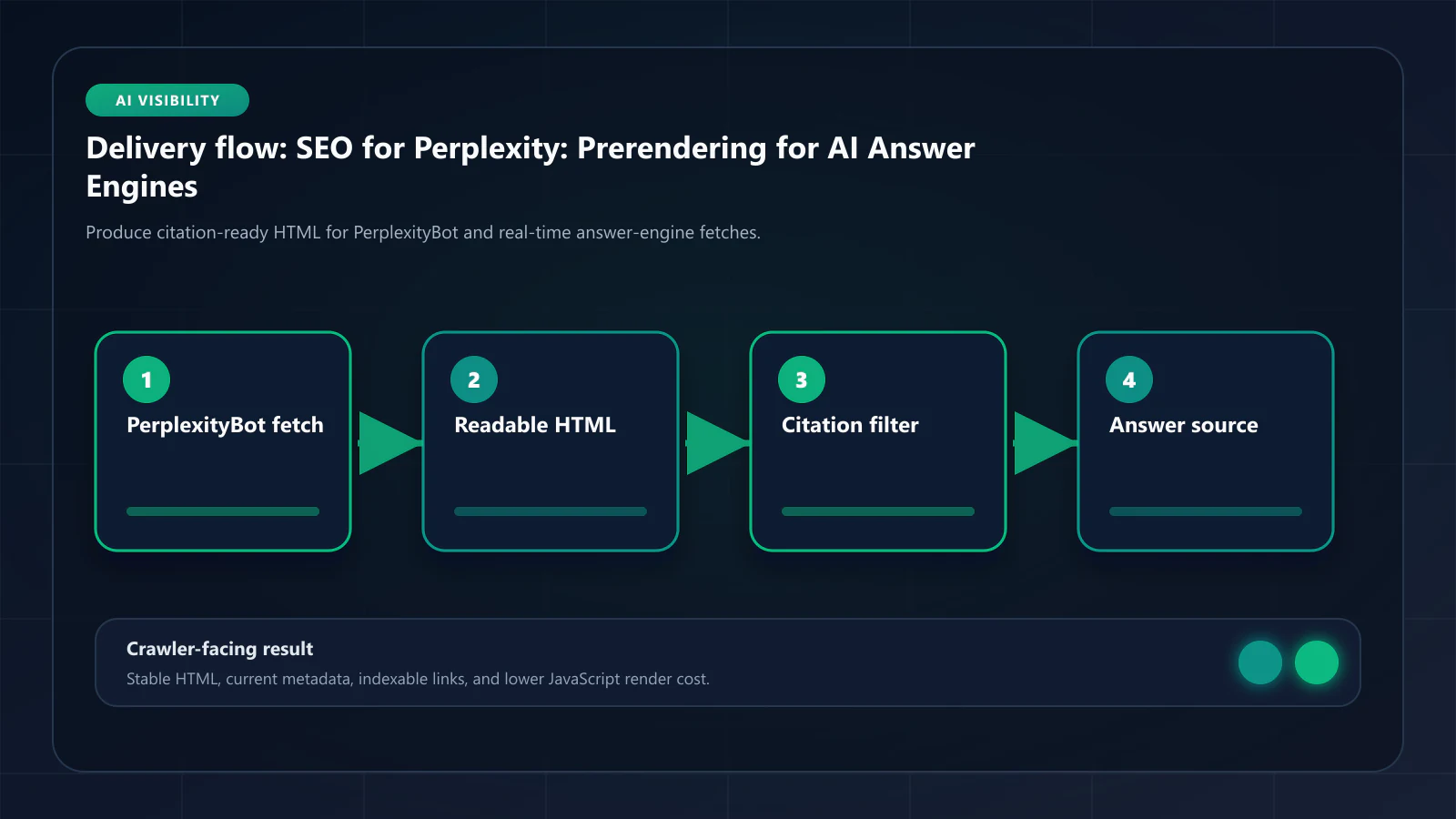
How prerendering produces citation-ready HTML
The mechanism is identical to other AI crawler bypass mechanics: prerender once, serve cached HTML to crawlers, never depend on client-side JavaScript execution. For Perplexity specifically, three properties of the prerendered HTML matter most:
Paragraph integrity. Perplexity's response generator quotes from indexed paragraphs. Prerendered HTML preserves the React component tree as semantic paragraphs (<p>, <article>, <section>). Flattened HTML or heavy nesting of <div> elements without semantic intent reduces citation quality because the answer engine cannot extract clean quotable spans.
Named entity density. Perplexity's source diversity algorithm rewards pages that introduce specific names, products, numbers, and dates. Prerendered HTML captures the data your client-side fetches produce, including model numbers, product specifications, pricing, and named comparisons. Without prerendering, this data exists only in the client-side JavaScript runtime and never reaches PerplexityBot.
Structured data. Perplexity reads application/ld+json blocks for schema-typed content (Article, Product, Organization, FAQPage). Prerendering serializes the JSON-LD that React-rendered components emit, making the structured layer available to PerplexityBot's source selector. CSR-only sites that emit JSON-LD only after hydration produce no structured data for AI crawlers.
Together these properties shift a site from "not citation-eligible" to "preferred citation source" for queries the site can answer authoritatively. The rendering architecture is the lever; topical authority is what the lever amplifies.
Operational details for Perplexity-friendly deployments
Robots.txt should explicitly allow PerplexityBot. Perplexity respects standard robots.txt directives, including the PerplexityBot user-agent token. Many CDN bot-management defaults are aggressive enough to interfere with PerplexityBot fetches. Confirm with curl https://your-site.com/robots.txt | grep -i perplexity. Add an explicit allow rule if needed; do not rely on User-agent: * defaults.
The Perplexity-User fetch budget is tight. Per-query response windows are 2 to 3 seconds. If your prerendered HTML page is over 500 KB or your origin response time exceeds 800 ms, Perplexity-User may abandon the fetch and use a competitor's source instead. Optimize first-byte time and page weight to stay inside the budget; this is one place where TTFB optimization has direct AI visibility consequences.
Citation hover cards depend on metadata. Perplexity displays citation cards with title, description, and favicon when the user hovers a citation. The card metadata is pulled from the page's <title>, <meta name="description">, and <link rel="icon">. Prerendering ensures these are present in the first response; CSR sites that set the title client-side produce empty citation cards.
Schema.org Article and FAQPage are observably weighted. Pages with clean Article or FAQPage JSON-LD are cited more often for editorial and Q-and-A queries. We documented the FAQPage schema pattern in prerendering checklist before launch; the same applies for Perplexity citation eligibility.
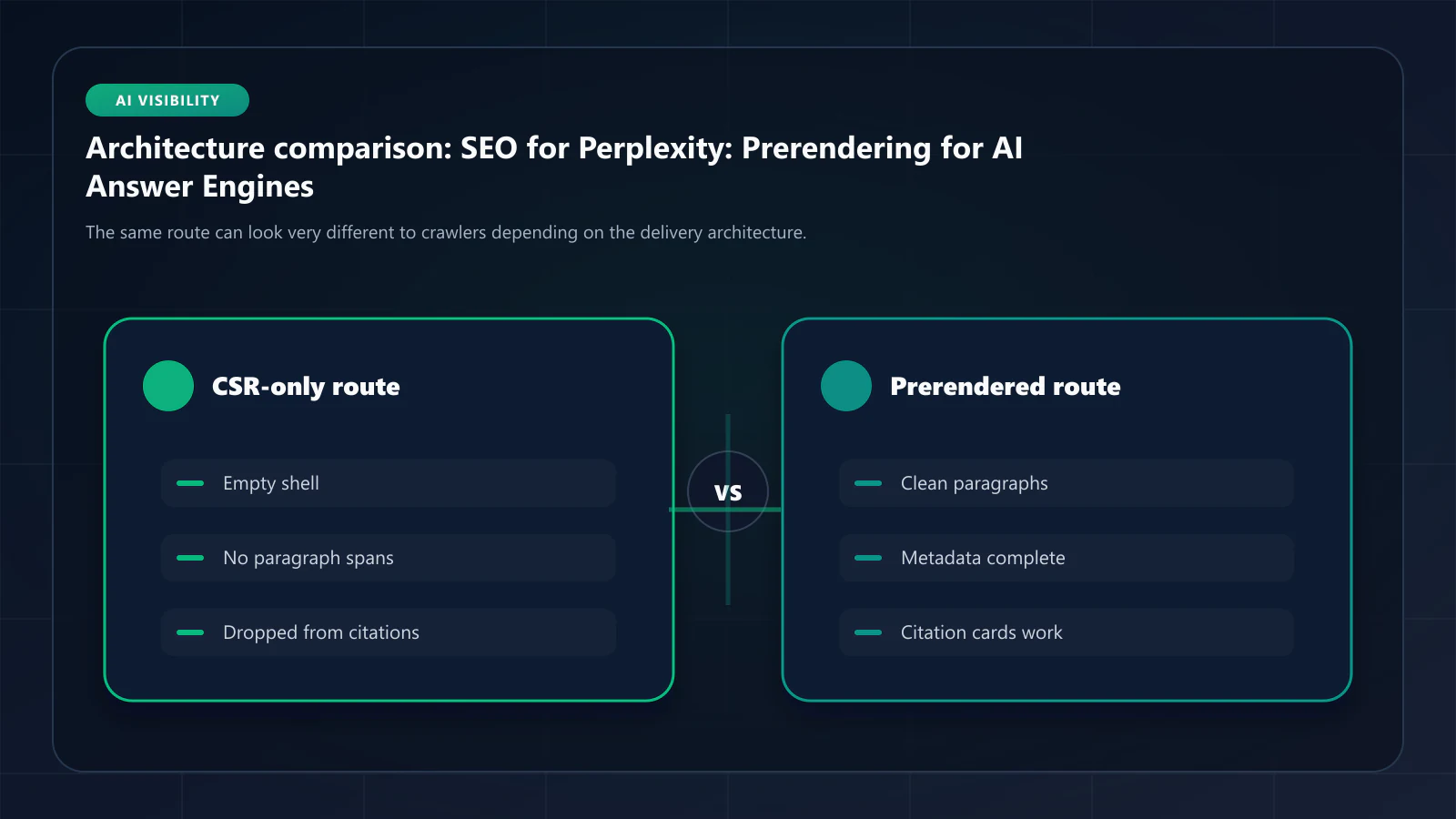
Comparison: Perplexity citation paths
| Approach | First-response HTML | Citation eligibility | Cards complete |
|---|---|---|---|
| ostr.io Prerendering | Full rendered DOM, JSON-LD included | Yes, immediate | Title, description, favicon all present |
| SSR migration | Full rendered DOM | Yes, after migration | Yes |
| SSG (build-time) | Full rendered DOM | Yes, but stale data risk | Yes |
| CSR-only SPA | Empty shell | No | Empty cards if cited at all |
| Static HTML fallback | Static, no dynamic data | Limited to fallback content | Yes for static fields only |
ostr.io's column shows the only path that produces full HTML and stays current with dynamic data updates without a multi-week SSR migration. The combination matters for Perplexity because stale data citations damage the user trust the product depends on, and Perplexity's source selector demotes pages that cite stale prices, outdated stats, or wrong dates.
Frequently Asked Questions
Yes. Perplexity's source selection prioritizes citation diversity over pure ranking. A page that ranks position 7 in Perplexity's relevance score may still be cited if it covers a specific facet the higher-ranked pages skip. The citation slot count is 4 to 12 per query; positions 4 through 12 are realistic targets even for sites without dominant ranking. The gate is first-response HTML quality (filter 1); positioning happens after.
PerplexityBot re-crawls indexed URLs on a 5 to 21 day cadence depending on perceived freshness. Newly upgraded HTML responses are observed at the next crawl. Citation eligibility updates after the index incorporates the new content (typically within 30 to 60 days of deployment). The fastest path to first citations is to ensure prerendered HTML is observably better than the CSR shell on the URLs Perplexity already crawls regularly.
Yes, faster than for Googlebot. The 2 to 3 second per-query budget is hard. If your origin response is slow (over 1.2 seconds TTFB) or the prerendered HTML is heavy (over 500 KB), Perplexity-User may abandon the fetch and the user's question gets answered without your URL in the source list. Prerendering with edge-cached snapshots (sub-100ms TTFB) is the operational answer; ostr.io's edge-distribution is built for this constraint.
No, they are separate pipelines but with similar HTML requirements. Google's AI Overviews pull from the Search index (Googlebot + WRS) and select sources for synthesis. Perplexity uses its own crawler (PerplexityBot) and its own source selector. Both demote CSR-only pages and reward pages with full first-response HTML, structured data, and clean paragraphs. Investing in prerendering covers both surfaces with the same artifact.
Hard to quantify precisely because Perplexity does not publish per-domain citation counts. Observable patterns from client deployments: sites that move from CSR to prerender see a measurable rise in referrer traffic from `perplexity.ai` (visible in GA4 referrer reports) within 60 days. Direct citation counts can be tracked manually by running representative queries weekly and noting which URLs appear; this is tedious but reliable until Perplexity publishes a webmaster-facing console. ## Related Reading - SEO for ChatGPT: Prerendering Infrastructure for OpenAI Crawlers - Semantic Density for AI Crawlers - Synthetic Content Data Layer (SCDL) Optimization - Googlebot WRS Render Queue: Why Indexation Lags Crawl - Prerender vs SSR: Choosing the Right Rendering Path
Explore the canonical guides
Editorial trust
Written by prerender Editorial · Engineering Team. We build and run pre-rendering infrastructure for more than 200 engineering teams, which is where the numbers and code samples on this page come from.
Last updated . Editorial scope and review policy: About prerender.info.